TL;DR — the key points at a glance
- For DACH SMBs and mid-sized companies, melibo, moinAI and Lime Connect (formerly Userlike) are the most relevant solutions – all with German or EU hosting and GDPR certification.
- For enterprises and contact centers with high call volumes, Parloa and Cognigy are the market leaders, but with much higher implementation effort and enterprise pricing.
- For mid-sized companies with a broad channel mix, BOTfriends and OMQ offer a good balance of features and setup effort.
- For international scale-ups with high English-language volumes, Ada.cx is a good fit – with compromises on EU hosting.
- GDPR and the EU AI Act are no longer optional in 2026: hosting within the EU, a data processing agreement (DPA) and the transparency obligation under Art. 50 of the AI Act are mandatory for every chatbot operated in Germany.
Definition · AI chatbot for businesses
An AI chatbot for businesses is a software system that processes and automatically answers customer inquiries in natural language using natural language processing (NLP) and large language models (LLMs). Unlike rule-based FAQ bots, it recognizes context, handles freely worded inquiries and can be integrated into back-end systems such as CRM, ERP or shop systems — for full process automation without human intervention.
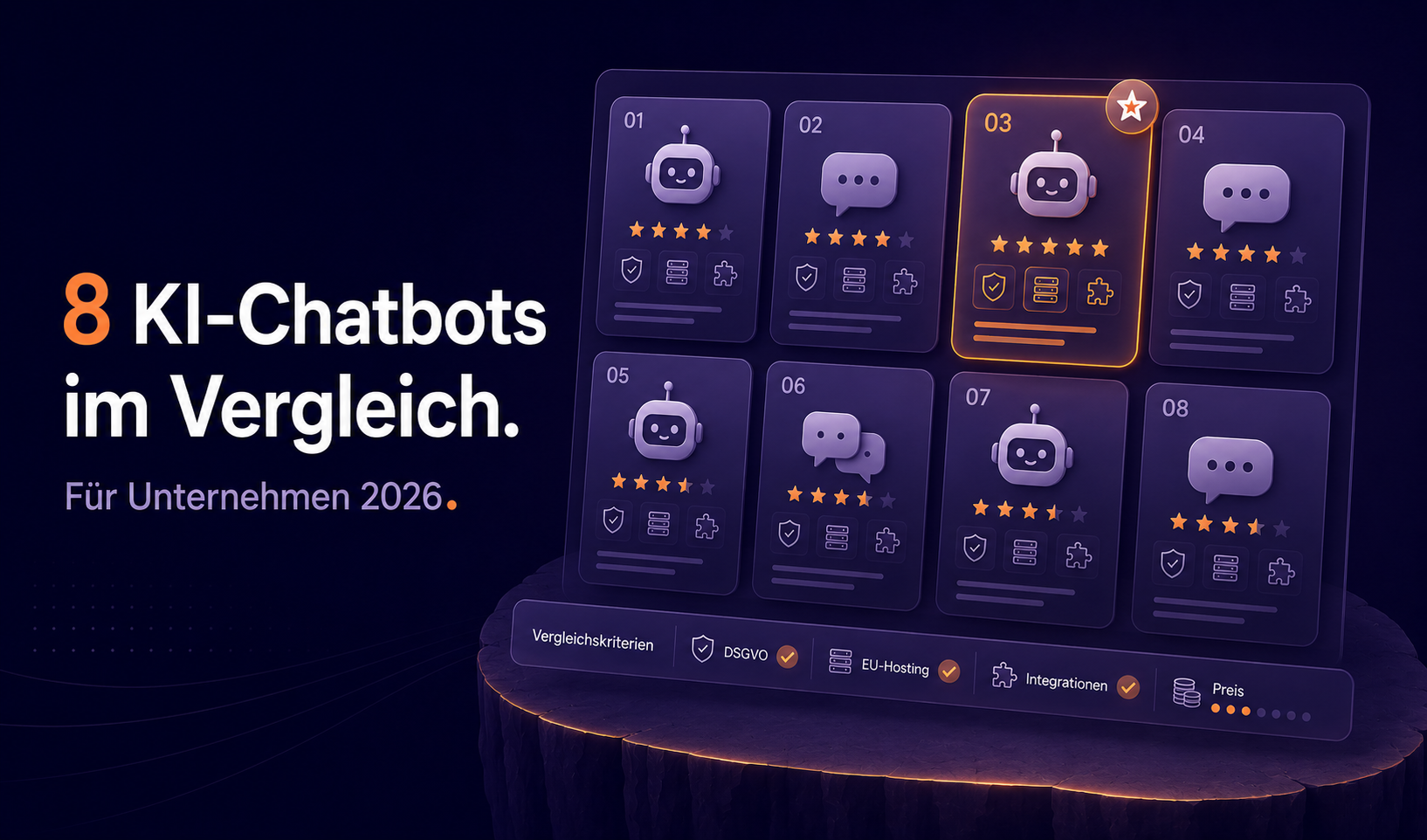
Finding the right AI chatbot for your company is more complex in 2026 than it was two years ago. The market has shifted: rule-based FAQ bots are being replaced by AI-powered AI agents that cancel orders, create returns and retrieve customer data in real time from shop and helpdesk systems. At the same time, GDPR compliance and the transparency obligation of the EU AI Act are no longer optional extras. This article compares the eight most relevant providers for the DACH market – with honest strengths, weaknesses and decision guidance for different company sizes and industries.
What makes a good AI chatbot for businesses?
Five factors decide in 2026 whether an AI chatbot really works for your business:
Degree of automation and depth of integration: a chatbot that only retrieves FAQ texts is outdated. What matters is whether the system can access order data, ERP entries or stock levels in real time and take actions on its own – for example create a return or change an address.
GDPR compliance and hosting location: for companies in Germany and the EU, EU hosting isn't optional, it's mandatory. Providers that route data through US sub-processors increase compliance risk. Since August 2025, Art. 50 of the EU AI Act also requires that users can recognize before the interaction that they're talking to an AI system.
Pricing transparency: some providers charge on a pay-per-resolution basis – you pay per resolved inquiry. That sounds fair, but becomes a cost trap as automation grows. Flat-rate models with a defined conversation volume are easier to plan.
Time to value: how quickly is a productive bot live? Modern no-code solutions manage it in a few days. Enterprise platforms like Cognigy or Parloa typically need 4 to 12 weeks of implementation plus external consultants, according to market reports.
Human handover quality: no AI system resolves 100% of inquiries. What matters is what happens with complex concerns. A clean handover process means the human agent sees the entire conversation history and doesn't have to ask the customer again.
The 8 best AI chatbot providers for businesses in 2026
1. melibo – best AI chatbot for e-commerce and mid-sized companies in DACH
melibo is a customer service automation platform from Bensheim near Frankfurt, founded in 2020 and specializing in AI chatbots and AI agents for mid-sized companies in the DACH region. All servers are in Germany, and the solution is GDPR-compliant and ISO-certified. Its distinguishing feature: native integrations with the most important shop, ERP and helpdesk systems in the DACH region without middleware.
Strengths: melibo is No. 1 in the chatbot category on OMR Reviews (as of Q2/2026) – an indicator that the platform delivers in practice. A key reason is its consulting and implementation approach: melibo guides companies through the entire rollout with its own AI experts – from automation strategy and conversation design to go-live. That sets it apart from pure self-service platforms where customers have to work out the configuration themselves.
Another unique selling point in the DACH market is the depth of its ERP integrations. While most chatbot providers stop at CRM and helpdesk, melibo connects AI agents natively with ERP systems such as Xentral, SAP and Microsoft Dynamics, as well as the multichannel ERP 4SELLERS, with which melibo has a close partnership. That enables process automation that goes far beyond FAQ answers: checking stock, updating orders directly in the ERP, combining delivery status from several sales channels – all fully automated in the chat.
Technically, melibo also connects AI agents directly with Shopware 6, Shopify, plentymarkets, Zendesk, Freshdesk, GREYHOUND and Salesforce. The bot can retrieve order status, return status and delivery addresses in real time and carry out cancellations on its own – without manual data exports. Customers such as Deuba report 40% fewer tickets and a drop in cost per ticket from €3.00 to €0.20; Lilienthal Berlin achieved 70% faster response times during the Q4 peak. Setup typically takes 4 weeks, often less with native connectors.
Weaknesses: voice bot functionality (phone) isn't melibo's focus – if you mainly want to automate phone channels, look at Parloa or Cognigy. WhatsApp marketing campaigns (newsletters, flows) aren't part of the product portfolio.
Best for: e-commerce merchants on Shopware or Shopify, B2B mid-sized companies with helpdesk integration, gyms and sports clubs, companies focused on GDPR-compliant hosting in Germany. Besides the Support Agent, melibo also offers a Sales Agent that actively advises visitors, recommends products and supports purchase decisions directly in the chat – without a sales rep having to step in.
Starting price: on request; typical monthly license for DACH mid-sized companies from €500.
Integrations: Shopware, Shopify, Xentral, plentymarkets, 4SELLERS, Zendesk, Freshdesk, GREYHOUND, Salesforce, SAP, Microsoft Dynamics.
More on features and integrations: melibo AI Agent at a glance · Shopware integration
2. moinAI – strongest self-learning system for marketing and sales
moinAI is an AI chatbot platform from Hamburg-based Knowhere GmbH, founded in 2015. The solution focuses on automated customer communication in website chat – with one special feature: from go-live, the AI keeps developing on its own through self-learning, recognizes new topics and generates answers without manual retraining.
Strengths: moinAI is one of the most-reviewed DACH solutions on OMR Reviews (149 reviews, as of Q2/2026) and scores with high usability without technical know-how. The system is hosted in Germany, GDPR-compliant and available in up to 98 languages. Customers such as Cyberport, Velux and Fressnapf rely on the platform. The built-in AI product advisor is especially useful for e-commerce stores with products that need advice.
Weaknesses: moinAI is mainly geared to chat interactions on the website and Facebook. Handover to a human agent requires external live chat software such as Lime Connect – an additional integration step. Deeper helpdesk integrations (Zendesk, Freshdesk) require third-party connectors such as Zapier. The service model is strongly do-it-yourself; strategic solution engineering for complex agent architectures isn't a core product.
Best for: companies that want to automate website chat for marketing, lead generation and product advice without a big IT team behind it.
Starting price: from €475–500/month (Starter).
Integrations: HubSpot, Shopify, Zapier, Zendesk (via third parties), Facebook.
3. Lime Connect (formerly Userlike) – strongest omnichannel platform for SMBs and mid-sized companies
Lime Connect is the successor to Userlike, renamed in 2024, and is developed by Cologne-based Lime Technologies. With over 15 years of experience, Lime Connect is one of the most established German messaging platforms for AI-powered customer service. The key difference from pure chatbot solutions: Lime Connect combines AI agents, a digital copilot for support staff and a shared team inbox for all channels in one platform.
Strengths: Lime Connect takes a clear omnichannel approach: website chat, WhatsApp, Instagram, Facebook, SMS and email all come together in one central inbox. That makes the support team's work much easier. Customers such as Toyota, Nivea, Hermes and Lindt use the platform. The system is developed and hosted in Germany and fully GDPR-compliant. The agent assist mode (copilot) supports human staff with suggested answers and summaries – especially strong for moderately complex inquiries.
Weaknesses: for pure e-commerce automation with deep shop back-end integration (e.g. Shopware order data in real time), Lime Connect is less deeply integrated than specialized shop solutions. ERP integrations such as Xentral or plentymarkets aren't included natively.
Best for: SMBs and mid-sized companies with omnichannel support requirements, companies prioritizing WhatsApp as a service channel, teams that want to combine chatbot and human support seamlessly.
Starting price: from approx. €90/month.
Integrations: WhatsApp, Instagram, Facebook, SMS, Zendesk, Salesforce, Shopify, HubSpot.
4. BOTfriends – strongest solution for chat and voice in one system
BOTfriends is a conversational AI platform from Würzburg, founded in 2017. Its special feature: besides text-based chat, BOTfriends also offers voice bots that can be used in phone routing systems, for example – a combination many pure chat platforms don't offer. Customers include TUI Cruises, Süwag and ROLLER.
Strengths: BOTfriends combines chat and voice automation in one platform and enables no-code creation without programming skills. Numerous preconfigured templates for different industries and use cases (booking platforms, internal purchasing, HR) shorten rollout time. Integrations with SAP, HubSpot, Salesforce and PayPal are available natively. BOTfriends has 51 verified reviews on OMR Reviews (as of Q2/2026).
Weaknesses: at €2,490/month and up, the entry price is much higher than for SMB-oriented solutions – so BOTfriends is positioned more for mid-sized companies and enterprises. For pure FAQ automation without voice needs, the value for money is less attractive. DACH-specific shop integrations (Shopware, plentymarkets) aren't part of the standard portfolio.
Best for: mid-sized companies and enterprises that want to run chat and phone automation from one platform, e.g. insurers, energy providers, logistics.
Starting price: from €2,490/month (Starter); enterprise on request.
Integrations: SAP, HubSpot, Salesforce, PayPal, further systems via API.
5. OMQ – strongest hybrid AI architecture with 14 years of experience
OMQ is a Berlin-based provider of AI-powered customer service that has been active in the market for over a decade. Its special feature: OMQ uses a hybrid architecture of NLP and modern LLMs such as GPT — a combination that, according to the provider, improves answer quality while keeping the knowledge base controllable. OMQ has 93 verified reviews on OMR Reviews (as of Q2/2026).
Strengths: OMQ covers several channels from one central knowledge base – website chat, email, messenger and help center pages all draw on the same source. Website sections and documents can be imported automatically via sync. The modular entry (e.g. help center first, then chatbot) enables a step-by-step rollout with predictable costs. The AI is pre-trained and, according to the provider, works at a level similar to ChatGPT.
Weaknesses: deep e-commerce integrations for DACH shop systems (Shopware, plentymarkets) aren't part of the standard offering. Voice bots aren't part of the product.
Best for: companies with high email volumes that want to serve several channels from one knowledge base and automate step by step.
Starting price: from €490/month (chatbot plan); modular entry with help center from €150/month possible.
Integrations: Zendesk, Freshdesk, Shopify, Salesforce, extensible via API.
6. Parloa – voice-first specialist for enterprise contact centers
Parloa was founded in Berlin in 2017 and has positioned itself as a specialized AI platform for phone and voice automation in enterprise contact centers. Customers include ERGO Group, Decathlon and Microsoft. Parloa mainly targets companies with high inbound call volumes.
Strengths: Parloa offers advanced speech recognition and synthesis for highly natural phone agents – a differentiator pure chat solutions don't cover. The visual drag-and-drop chatbot builder allows channel-specific answer definitions. Parloa integrates with SAP, Zendesk, Freshdesk, HubSpot and Salesforce and is designed for contact-center-as-a-service (CCaaS) infrastructures.
Weaknesses: Parloa is clearly voice-first – text-based channels such as website chat, WhatsApp or social media aren't the core product. According to various market reports, implementation typically takes 4 to 12 weeks. Pricing is enterprise-oriented and only available on request. For e-commerce companies that mainly want to automate chat channels, Parloa isn't an obvious choice.
Best for: insurers, telecom companies, utilities and large contact centers with high inbound call volumes.
Starting price: on request; enterprise pricing, project-based implementation.
Integrations: SAP, Zendesk, Freshdesk, HubSpot, Salesforce, CCaaS infrastructures.
7. Cognigy – leading enterprise platform for global corporations
Cognigy was founded in Düsseldorf in 2016 and has grown internationally into one of the best-known enterprise platforms for conversational automation. Customers include Bosch, Henkel and Lufthansa. At its heart is a low-code flow editor that enables both text- and voice-based bots in over 100 languages. As one of the few solutions on the market, Cognigy offers flexible on-premise options.
Strengths: Cognigy is designed for maximum scalability and security standards – especially thanks to the on-premise option, which is relevant for regulated industries such as banks, insurers or public authorities. LLM orchestration lets you steer different AI models and providers intelligently. A strong agent copilot mode supports human agents with complex inquiries.
Weaknesses: Cognigy is clearly enterprise-focused – SMBs aren't a priority. Implementation typically takes 4 to 12 weeks, and prices are in the five- to six-figure range per year, according to market reports. That makes the solution too complex and too expensive for the typical DACH mid-sized company. DACH-specific shop integrations for Shopware or plentymarkets aren't part of the standard portfolio.
Best for: global corporations and large organizations with complex, multilingual requirements that want to run text and phone automation from one platform.
Starting price: on request; typically a five- to six-figure annual amount.
Integrations: Salesforce, SAP, Zendesk, Freshdesk, Microsoft Dynamics, on-premise option available.
8. Ada.cx – strongest international solution for English-speaking scale-ups
Ada.cx is a Canadian AI chatbot provider focused on autonomous customer communication in English. The platform claims to resolve up to 83% of support inquiries autonomously. Ada targets international companies and scale-ups with high English-language support volumes.
Strengths: Ada.cx offers a no-code interface, A/B testing and broad channel coverage. The AI learns from customer interactions and handles typos, idioms and defined keywords flexibly. For international companies whose main volume is outside the DACH region, Ada is a powerful option.
Weaknesses: Ada.cx is based in Canada. For companies in Germany and the EU, that means more GDPR due diligence: server location, DPA and the question of US sub-processors need careful review. Native integrations with DACH-specific systems such as Shopware, plentymarkets or GREYHOUND aren't available. German language quality and understanding of the DACH market aren't the provider's focus.
Best for: internationally oriented scale-ups and e-commerce companies with a mainly English-speaking customer base looking for a powerful no-code platform.
Starting price: on request; enterprise pricing.
Integrations: Zendesk, Salesforce, Shopify, extensible via API.
Comparison table: AI chatbot providers for businesses in 2026
AI chatbot providers compared 2026
Filter by use case or target group — all information as of June 2026.
| Provider | Hosting | GDPR | Target group | Strength | Starting price |
|---|---|---|---|---|---|
| melibo | Germany | Yes, ISO-certified | SMB & enterprise, e-commerce, B2B | No. 1 on OMR Reviews · native DACH integrations (Shopware, Xentral, 4SELLERS, SAP) · AI expert consulting · Support & Sales Agent | from approx. €500/mo. |
| moinAI | Germany | Yes | SMB, marketing & sales | Self-learning · product advice · 98 languages | from €475/mo. |
| Lime Connect | Germany | Yes | SMB & mid-sized | Omnichannel · WhatsApp · central team inbox | from €90/mo. |
| BOTfriends | Germany | Yes | Mid-sized & enterprise | Chat + voice in one system · SAP, Salesforce | from €2,490/mo. |
| OMQ | Germany | Yes | Mid-sized | Hybrid AI architecture · modular entry · 14 years of experience | from €490/mo. |
| Parloa | EU/SaaS | Yes | Enterprise contact centers | Voice-first · phone automation · CCaaS integration | On request |
| Cognigy | EU / on-premise | Yes | Global enterprise | 100+ languages · on-premise · LLM orchestration | On request |
| Ada.cx | Canada/USA | Check | International, scale-ups | High autonomy rate · no-code · A/B testing | On request |
Sources: OMR Reviews Q2/2026 · own research as of June 2026. Prices without guarantee; individual terms available from all providers on request.
GDPR and the EU AI Act in 2026: what to consider when choosing a provider
Choosing an AI chatbot in 2026 is also a compliance decision. Two sets of rules apply in parallel:
Under Art. 28, the GDPR requires you to conclude a data processing agreement (DPA) with every service provider that processes personal data. Customer conversation data must not be used to train third-party models. Providers with US sub-processors call for extra diligence – the EU-US Data Privacy Framework remains controversial among lawyers, and data protection experts don't rule out a "Schrems III" ruling.
Since August 2025, the EU AI Act (Regulation 2024/1689) requires under Art. 50 that users be informed before interacting with an AI system. A notice such as "Hi, I'm an automated assistant" in the chat widget is mandatory. Learn more: GDPR-compliant AI chatbots: what companies need to know.
The German Federal Office for Information Security (BSI) explicitly recommends hosting within the EU, ideally in Germany, for sensitive sectors such as healthcare, finance and public administration. Providers that both host in a GDPR-compliant way and supply a completed DPA and a list of sub-processors by default make compliance documentation much easier.
Which AI chatbot fits which company?
The right choice depends on three factors: company size, main channel and depth of integration.
For e-commerce merchants on Shopware or Shopify in the DACH region, a native shop integration is crucial. Chatbots that can retrieve order status, return status and product availability in real time from the shop back end automate the most common inquiries without manual data maintenance. Learn more: Shopware chatbot: automate AI customer service for your store.
For B2B mid-sized companies with a helpdesk (Zendesk, Freshdesk, GREYHOUND), seamless handover between AI agent and human agent is critical. The bot has to categorize tickets correctly, pass on relevant context data and follow escalation rules.
For companies with high call volumes – insurers, telecoms, utilities – voice-first solutions such as Parloa or Cognigy are the right choice. Pure chat platforms can't serve this niche sensibly.
For SMBs with a small budget who want to start quickly, Lime Connect (from €90/month) and moinAI (from €475/month) offer the lowest entry point with GDPR-compliant German hosting.
Further reading: Chatbot vs. AI agent: what's the difference? · At what ticket volume does an AI agent pay off?
Free strategy call
Now you know which AI chatbot fits which company.
Let's work out together what the right next step is for your business.
In a free 30-minute call, our AI experts analyze your ticket volume and system landscape and show you which level of automation makes sense for your setup — no sales pressure.
Book a free call →Frequently asked questions (FAQ)
Which AI chatbot is best for companies in Germany in 2026?
There's no universally "best" AI chatbot – the right choice depends on company size, channel and depth of integration. For e-commerce and DACH mid-sized companies with a Shopware or Shopify connection, melibo is the most deeply integrated solution. For omnichannel communication including WhatsApp, Lime Connect (formerly Userlike) is well positioned. For enterprise contact centers focused on the phone, Parloa and Cognigy lead the market.
How much does an AI chatbot for businesses cost per month?
The price range is wide: SMB solutions such as Lime Connect start at €90/month, moinAI and OMQ at approx. €475–490/month. Mid-market solutions such as melibo typically start at €500/month. Enterprise platforms such as BOTfriends (from €2,490/month), Parloa and Cognigy work with individual enterprise pricing that's only available on request. Watch out for hidden costs: pay-per-resolution models get expensive when automation succeeds.
Does an AI chatbot in Germany have to be GDPR-compliant?
Yes. Every chatbot that processes personal data – and every chat interaction does – is subject to the GDPR. You need a DPA with the provider, and EU hosting is preferred by supervisory authorities and the BSI. Since August 2025, the EU AI Act (Art. 50) also requires that users can recognize they're talking to an AI.
What's the difference between an AI chatbot and an AI agent?
An AI chatbot usually answers questions from a knowledge base. An AI agent goes further: it carries out actions in connected systems on its own – for example canceling an order, changing a delivery address or creating a return label – without a human stepping in. In 2026, the line between the two is increasingly blurred, as modern AI chatbots act more and more agentically. Learn more: What is an AI agent?
How long does it take to introduce an AI chatbot?
Modern no-code platforms with native connectors can be productive within a few days to 2 weeks. Enterprise solutions such as Cognigy and Parloa typically need 4 to 12 weeks of implementation – plus external consultants and consulting costs. Providers with preconfigured integrations for your system landscape (e.g. Shopware, Zendesk) shorten this effort considerably.