
TL;DR — The essentials in 30 seconds
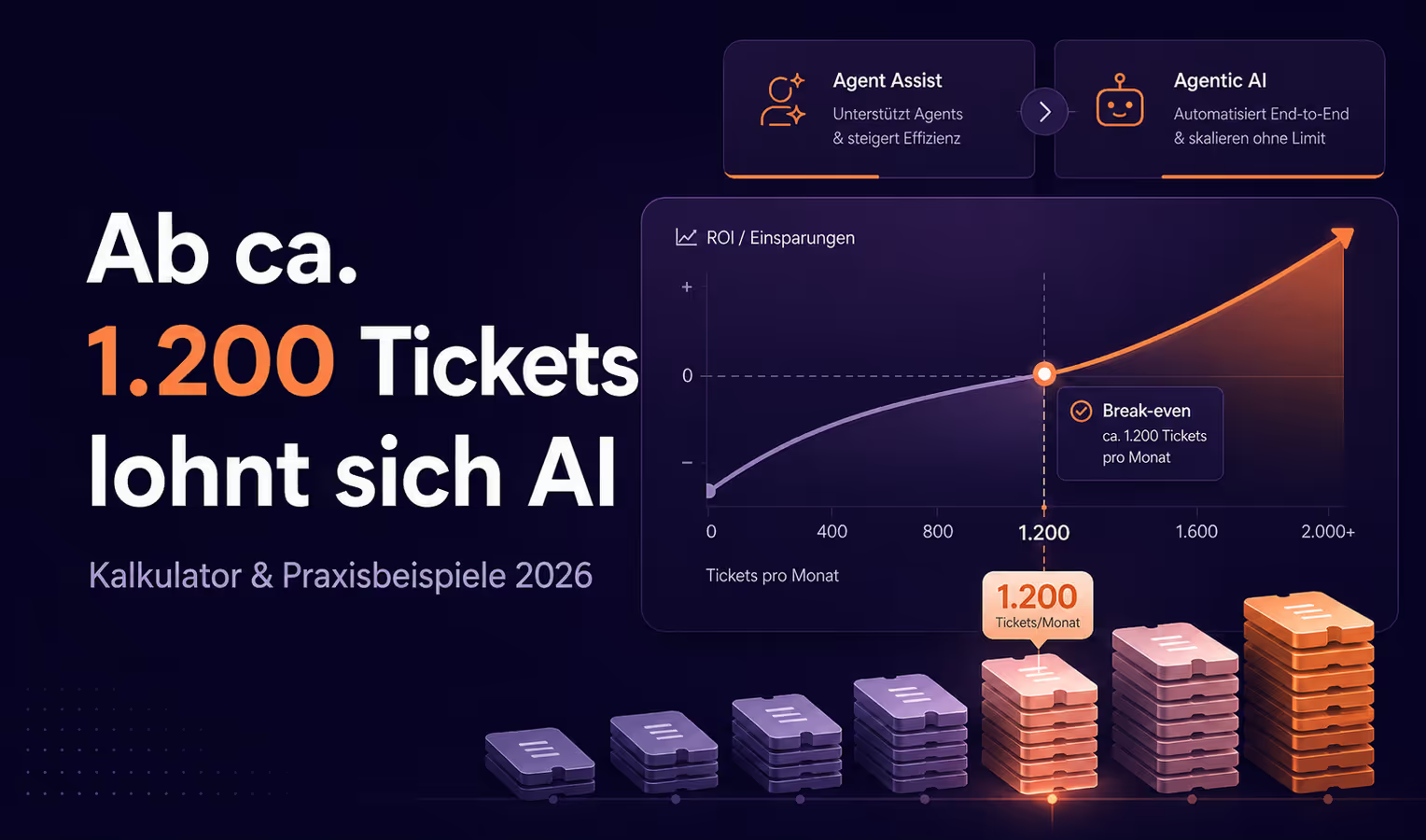
- Rule of thumb: from around 1,200 support tickets a month, cost savings typically outweigh the total cost of ownership of a fully automated AI agent (agentic AI).
- Two levels of automation: agentic AI resolves requests completely without human intervention (realistically ~40% of tickets); Agent Assist speeds up human handling without replacing it (another ~20–25%). Combined, 60%+ is achievable.
- Average handling time: in DACH customer service, it's around 6 minutes per ticket — the baseline for the ROI calculation.
- Below 600 tickets/month, an Agent Assist approach or a rule-based FAQ chatbot is recommended first, rather than a full agentic AI system.
Definition · AI agent ROI threshold
The ROI threshold of an AI agent is the point at which the monthly cost savings from automated ticket handling exceed the sum of license fees, setup effort and ongoing maintenance. In DACH customer service, it's typically around 1,200 tickets a month for fully automated solutions (agentic AI) and varies with automation level, hourly rate and system complexity.
Many customer service leaders ask the same question: when does switching to an AI agent really pay off — and not just on paper? The answer depends on three variables: your monthly ticket volume, the average handling time per ticket (around 6 minutes on average in the DACH region) and your support staff's hourly rate. Then there's an important distinction most ROI calculators miss: not every automated ticket is the same. This article gives you a transparent formula, an interactive calculator and industry benchmarks to work out your personal break-even in under five minutes.
The rule of thumb: agentic AI pays off from 1,200 tickets/month
A fully automated AI agent (agentic AI) pays off as soon as the avoided staff costs exceed the total cost of ownership. For a typical mid-sized DACH company with an hourly rate of €45, a handling time of 6 minutes per ticket and a realistic full automation rate of 40%, the numbers look like this:
Agentic AI vs. Agent Assist: what's the difference?
Most ROI calculators only know one number: the automation rate. In practice, there are two fundamentally different levels that you need to look at separately — because they deliver different savings and suit different ticket types.
Agentic AI resolves a ticket completely on its own, without an employee stepping in. This works well for clearly defined standard requests: order status, return status, opening hours, password resets, FAQs. Around 40% of all incoming tickets is realistic. For each fully automated ticket, you save the entire handling time — 6 minutes on average in the DACH region.
Agent Assist works differently: the AI agent suggests replies, summarizes context or fills in fields — but the human decides and sends. This is a good fit for semi-complex requests such as complaints, contract inquiries or level-1 technical support. It covers around 20–25% of tickets, saving 2–3 minutes per ticket. melibo explains how AI agents in customer service work in a separate article.
Combining both levels gives you an effective automation level of over 60% — significantly more than the 40% shown by pure agentic AI calculations.
Note on the calculation: automation rates of 80–90% are often cited in marketing materials. They usually only apply to very homogeneous request profiles (e.g. pure FAQ bots without backend integration). Plan conservatively: 40% full automation + 20–25% Agent Assist is a realistic, reliable scenario. Sources: Gartner Customer Service AI 2025 · Bitkom: AI in customer service 2025.
Your personal break-even calculator
Adjust the sliders to your business. The calculator separates full automation (agentic AI) and partial automation (Agent Assist) — the result updates in real time.
Free ROI calculator
When does an AI agent pay off for your company?
* AI agent license costs for mid-sized DACH companies: typically €500–1,500/month. One-off setup costs not included.
Industry benchmarks: what's realistic in practice?
The following figures are based on published case studies, industry reports (Bitkom 2025, Gartner 2025) and typical project parameters.
E-commerce (Shopware / Shopify)
Online shops are among the biggest beneficiaries of AI agents, because most incoming requests boil down to the same few questions: where's my parcel? How do I return something? Is my voucher code still valid? These tickets can be fully automated via native connections to Shopware 6 or Shopify — including real-time order data, without manual lookups. Typical ticket volume: 1,500 to 5,000 a month, with clear peaks in Q4. Agentic AI reaches around 40% here, Agent Assist another 25%. At an hourly rate of €45 and 6 minutes of handling time, that's monthly savings of €3,000 to €8,500.
In concrete terms: a shop with 1,500 tickets a month saves around €3,600 through 40% full automation — plus about €700 through Agent Assist, almost €4,300 a month in total.
Gyms and sports clubs
Gyms often have smaller support teams and a strong seasonal pattern: most requests come at the start of the year, when many memberships are signed or canceled. The most common topics are class schedules, opening hours, prices and pausing or canceling memberships. Agentic AI works well for FAQ requests, while Agent Assist saves a lot of time on contract-related ones. Typical ticket volume is between 400 and 1,200 a month, with an agentic AI rate of around 35% and Agent Assist another 25%. At an hourly rate of €38, that's monthly savings of €700 to €2,100. The break-even for agentic AI is only reached from 900–1,200 tickets — below that, a chatbot built for gyms is the better first step.
Mid-sized B2B companies with a helpdesk
In B2B, the range of requests is broader than in e-commerce. Password resets, order status, invoice requests and product documentation can be fully automated well. Semi-complex tickets such as contract changes or initial technical assessments suit Agent Assist — handling time drops significantly without fully replacing the employee. What's crucial is a clean handover between AI agent and human agent; for that, helpdesk systems such as Zendesk, Freshdesk or GREYHOUND need to be connected natively. Typical ticket volume is between 800 and 3,000 a month. Agentic AI and Agent Assist each reach around 35% and 25%. At an IT support hourly rate of €50–60, that's monthly savings of €2,000 to €7,000.
How much does an AI agent cost?
Monthly license costs for a full AI agent at mid-sized DACH companies are typically between €500 and €2,500 — depending on volume, integration depth and provider. On top come one-off setup costs of €1,500 to €8,000, which are much lower for solutions with native connectors. Ongoing internal maintenance is around 2–5 hours a month: FAQ updates, new topics, quality control. A helpdesk integration costs €0–2,000 one-off — with native connectors for Zendesk, Freshdesk or GREYHOUND, this item disappears.
In total, you should expect costs of around €9,000 to €40,000 in the first year; from the second year, these drop to €6,000–30,000 as the setup costs fall away.
DACH provider comparison 2026
The market for AI customer service solutions in the DACH region is manageable. The relevant differences lie in hosting location, GDPR certification and the scope of native integrations.
melibo hosts in Germany, is fully GDPR-certified and offers native integrations for Shopware, Shopify, Xentral, Zendesk, Freshdesk, GREYHOUND, Salesforce and SAP. The solution is aimed at SMEs and enterprises in e-commerce and B2B. Pricing on request.
Userlike also hosts in Germany with GDPR certification. The focus is on live chat for SMEs, with integrations for Zendesk, Salesforce and Shopify. Starts at around €90 a month.
Tidio hosts in the EU (Ireland) with partial GDPR coverage. Its strengths lie in e-commerce with Shopify, WooCommerce and Magento integration. From around €29 a month.
Intercom hosts in the US and EU (partly GDPR-compliant) and targets SaaS and tech companies with Salesforce, HubSpot and Zendesk integration. From around $74 a month.
Freddy is natively integrated into Freshdesk and included in the Freshdesk plan. Hosting in the US/EU, GDPR partly covered. Hardly flexible outside the Freshdesk ecosystem.
Botpress is an open-source framework with flexible hosting (cloud or self-hosted). Integrations are API-based and require in-house development. Aimed at developer teams, from $495 a month for the cloud version.
Providers like melibo, which host in Germany and offer native integrations for Shopware, Xentral and GREYHOUND, let you get started without a major IT project. Order data, customer records and ticket history are directly available to the AI agent — with no manual data exports or middleware.
Below the ROI threshold: when is an FAQ chatbot enough?
Not every company has 1,200 tickets a month right away. That doesn't mean automation is pointless — just that a different form of it is appropriate. See also our comparison Chatbot vs. AI agent: what's the difference?
Below 300 tickets a month, a good FAQ page with a contact form is usually enough — it reduces incoming emails with no extra investment. Between 300 and 600 tickets, a rule-based FAQ chatbot from around €50 a month pays off by relieving the team at peak times. Between 600 and 1,200 tickets, Agent Assist makes sense, but agentic AI is still borderline — the ROI depends heavily on the hourly rate. From 1,200 tickets, agentic AI is clearly recommended, with break-even typically within 3–6 months.
As your company grows, keep an eye on the threshold. Many providers allow a seamless upgrade from a rule-based bot to a full agentic AI system using the same knowledge base — without a new rollout.
GDPR, the EU AI Act and hosting: what to watch for in 2026
Since the EU AI Act began coming into force in stages from 2024, companies in the DACH region face concrete requirements — including for AI systems in customer service.
GDPR compliance under Art. 5 and 28 GDPR requires that personal data is only processed on the basis of a data processing agreement (DPA). Customer data must not be used to train third-party models.
Since 2025, the EU AI Act has required transparency: users must be able to recognize that they're interacting with an AI system. A corresponding notice in the chat interface is mandatory under Art. 50 of the EU AI Act (Regulation 2024/1689).
For the hosting location, Germany's Federal Office for Information Security (BSI) explicitly recommends hosting within the EU, ideally in Germany, for sensitive industries such as healthcare, finance or public administration. Also look for model transparency: providers using models like Mistral, Llama or GPT-4o should document where they're hosted.
As a technical safeguard against misinformation, retrieval-augmented generation (RAG) is recommended: the model only accesses your own knowledge data, which significantly reduces hallucinations.
Practical tip for IT managers: always ask the provider for a completed DPA and a list of subprocessors. Providers like melibo, which host in Germany and keep all data flows within the EU, supply these documents as standard.
Frequently asked questions (FAQ)
From how many tickets a month does an AI agent really pay off?
The rule of thumb is around 1,200 tickets a month for a fully automated AI agent (agentic AI). More precisely: if the monthly savings from full automation (tickets × 40% × 6 min × hourly rate) plus the Agent Assist savings exceed the total cost of ownership, the step makes economic sense. At an hourly rate of €55, the threshold can be as low as 900–1,000 tickets.
What's a realistic automation rate for customer service?
There are two different levels of automation that you should look at separately: agentic AI (full automation without human intervention) realistically covers around 40% of tickets — for clearly defined standard requests such as order status, returns or FAQs. Agent Assist (AI support for human agents) covers another 20–25%, raising overall effectiveness to over 60%. Promises of 80–90% full automation only apply to very homogeneous request profiles and should be questioned critically.
How much does an AI agent for customer service cost per month?
Monthly license costs for a full AI agent at mid-sized DACH companies are between €500 and €2,500 a month, depending on provider and features. On top come one-off setup costs (typically €1,500–8,000) and ongoing internal maintenance of around 2–5 hours a month. With native integrations (e.g. into Shopware or Zendesk), setup effort drops considerably.
Does an AI agent for the German market have to be GDPR-compliant?
Yes. As soon as the AI agent processes personal data — which is the case in almost every customer interaction — the GDPR applies. You need a data processing agreement (DPA) with the provider. Since 2025, the EU AI Act has also required that users can recognize they're talking to an AI system. Supervisory authorities and the BSI prefer hosting within the EU.
How long does it take to introduce an AI agent?
Implementation time depends heavily on the complexity of your system landscape. With native integrations into common shop and helpdesk systems (Shopware, Zendesk, Freshdesk), your first productive AI agent can go live in 4 weeks. Custom connections to ERP systems such as SAP or Xentral need more lead time. Providers that offer preconfigured connectors reduce this effort considerably — go-live becomes a configuration project rather than an IT project.