
AI agents vs. chatbots: what's the difference — and what does your customer service really need?
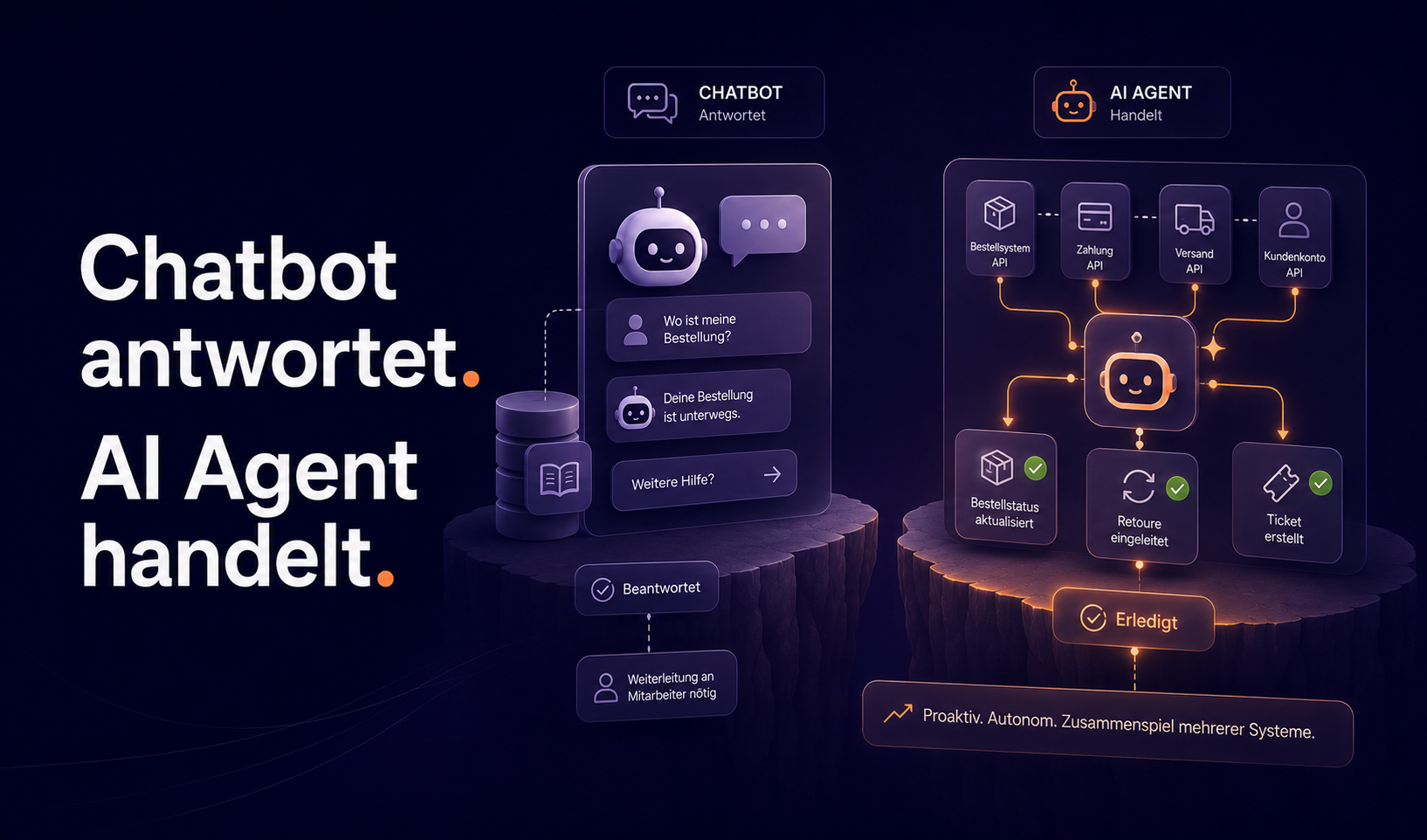
Chatbots and AI agents are almost always mentioned in the same breath. That's the problem. The two technologies solve fundamentally different tasks — and if you mix them up, you either invest too much too early or stop halfway. The difference comes down to one sentence: a chatbot answers. An AI agent acts.
Definition:
A chatbot is a software system that answers user requests automatically — either rule-based or AI-powered using a knowledge base. It provides information, routes or escalates to a human, but doesn't take independent actions in connected systems.
Definition:
An AI agent is an autonomous AI system that plans and carries out tasks on its own, accessing external tools, APIs and data sources. In customer service, that means checking order status, starting returns, creating tickets — all without human steps in between.
What a chatbot can do — and why that's not nothing
A chatbot answers questions based on a knowledge base. Opening hours, return periods, product availability, prices — modern AI chatbots phrase answers in natural language, recognize requests and route them. That covers a real, measurable share of daily support volume.
What a chatbot can't do is act in systems. It knows the shipping rules, but it can't pull the order status from Shopware or plentymarkets. It knows how a cancellation works, but it can't carry one out. For anything beyond answering, a chatbot needs either a human agent — or an AI agent. Classic chatbots typically fully resolve 20 to 40 percent of all incoming tickets. The rest still ends up with the support team.
What an AI agent does on top
An AI agent thinks in steps. It receives a request, plans the approach, retrieves the information it needs and carries out the action — in one conversation, with no human involved. A customer asks about their parcel: the agent retrieves the order number, checks the shipping status directly in Shopware, detects a delay and proactively offers a solution. All in under two seconds, with no ticket and no queue. melibo explains exactly how AI agents work in customer service in the guide AI agents in service: how they change processes — and how to get started.
This difference shows in the numbers. Around 40 percent of tickets can be resolved by fully agentic AI. Another 20 to 25 percent benefit from Agent Assist — the AI agent prepares the reply, a human confirms it with one click. Combined, that's over 60 percent of total ticket volume. That's more than twice what a classic chatbot achieves on its own. According to a Gartner analysis of customer service AI use cases, autonomous AI agents are already among the most strategically relevant investments in customer service. The Gartner forecast from March 2025 is even clearer: by 2029, agentic AI will autonomously resolve up to 80 percent of common customer service issues — a time horizon that shows where things are heading, but doesn't yet reflect today's maturity.
Promises of 80 to 90 percent full automation today sound tempting, but they only apply to very homogeneous request profiles without backend integration. For mixed ticket portfolios — typical in e-commerce, B2B or gyms — a realistic expectation is 40 percent full automation plus 20 to 25 percent Agent Assist. That AI in German companies has moved well beyond pilots is confirmed by a Bitkom press release from September 2025: one in three companies in Germany already actively uses AI — almost twice as many as a year earlier.
When does what pay off — deciding by volume
For mid-sized companies in the DACH region, the economic threshold for agentic AI is around 1,200 tickets a month. Below 600 tickets, an AI chatbot is enough. In between, Agent Assist is the sensible place to start. The depth of automation grows with volume — and so does the investment, which clearly pays off above a certain threshold.
The rule of thumb behind it: at an hourly rate of €45, a handling time of 6 minutes per ticket and a 40 percent full automation rate, monthly savings exceed license costs from around 1,200 tickets. Break-even is then typically reached within 3 to 6 months. More on ROI calculation on the melibo pricing page.
Why “either-or” is still the wrong question
Chatbot logic and AI agent capabilities aren't mutually exclusive — they're layers of the same system. In practice, the chatbot layer answers simple FAQs and qualifies the request. The AI agent takes over transactional tickets: order status, returns, address changes. Agent Assist handles the semi-complex cases in between, where a human has to decide — the agent prepares, the human confirms with a click.
This three-tier model combines low entry costs with deep automation and human control. Providers like melibo, which offer native integrations for Shopware, Zendesk, Freshdesk and GREYHOUND, let you build up step by step on the same knowledge base — moving from chatbot to AI agent isn't a migration project but a configuration decision.
What really matters when choosing a system
The most important selection criterion isn't the automation rate in the brochure but the depth of native integrations. The deeper an AI agent is integrated into Shopware 6, Shopify, Xentral, SAP, Zendesk, Freshdesk or GREYHOUND, the more tickets it can truly resolve without human intervention — no manual data exports, no middleware, no interface projects.
Then there's the regulatory framework: since the EU AI Act came into force, there's a transparency obligation (Art. 50, Regulation (EU) 2024/1689) — users must be able to recognize that they're interacting with an AI system. A data processing agreement (DPA) under Art. 28 GDPR is mandatory as soon as the agent processes customer data. melibo explains what this means in practice in How to use chatbots in your company in a GDPR-compliant way. For choosing a secure cloud provider, Germany's Federal Office for Information Security (BSI) recommends its C5 criteria catalog as an audit standard — melibo hosts exclusively in Germany.
Free strategy session
Now you know the difference.
Let's find out which level fits your support.
In a free 30-minute call, we'll look at your ticket volume and top use cases and show you whether a chatbot, Agent Assist or a full AI agent is the right fit — no sales pressure.
Book a free call →Frequently asked questions
What's the difference between a chatbot and an AI agent?
A chatbot answers questions based on stored rules or a knowledge base and doesn't take actions in connected systems. An AI agent plans tasks in several steps, accesses APIs, ERPs and CRMs, and resolves requests completely without human intervention. The difference in one sentence: a chatbot answers, an AI agent acts.
Can an AI agent replace a chatbot?
Not necessarily. In most setups, the chatbot is the first layer — it answers simple FAQs and qualifies requests. The AI agent takes over transactional and multi-step tasks. Both can build on the same knowledge base and complement each other.
What automation rate is realistic with an AI agent?
For mixed request profiles in DACH customer service: around 40 percent full automation through agentic AI plus another 20 to 25 percent through Agent Assist — combined, over 60 percent of total ticket volume. Promises of 80 to 90 percent only apply to FAQ-heavy, very homogeneous profiles without backend integration.
Does an AI agent have to be GDPR-compliant?
Yes. As soon as an AI agent accesses customer data, order history or system data, the GDPR applies in full. You need a DPA with the provider. Since 2025, the EU AI Act also requires that users can recognize they're interacting with an AI system (Art. 50, Regulation 2024/1689). The BSI explicitly recommends hosting within the EU for sensitive industries.
When does an AI agent pay off instead of a chatbot?
For mid-sized companies in the DACH region, the economic threshold for a fully automated AI agent is around 1,200 tickets a month. Below 600 tickets, an AI chatbot is enough. Between 600 and 1,200, Agent Assist is the sensible place to start — it significantly reduces handling time per ticket without the complexity of a full agentic AI integration.
Which systems can an AI agent connect to?
Powerful platforms connect natively to Shopware 6, Shopify, Xentral, SAP and Microsoft Dynamics on the shop and ERP side, to Zendesk, Freshdesk and GREYHOUND on the helpdesk side, and to CRMs such as Salesforce and HubSpot. The deeper the native integration, the lower the setup effort.
Conclusion
AI agents and chatbots aren't competitors — they're two different answers to the same question: how much should customer service really deliver? A chatbot answers. Fast, reliably, around the clock. An AI agent goes one step further and acts — it retrieves data, triggers processes, closes cases. If you understand the difference, you're not making a technology decision. You're making a strategic decision about what your customer service should become.