

Introduction: from idea to action
Imagine a world where customer requests aren't just answered but handled automatically: returns, invoices, status requests, data updates – without manual clicks. Sounds futuristic? With AI agents, it's already possible today.
AI agents understand what someone wants and take action themselves. Instead of just providing information, they carry out steps, integrate with your systems and execute processes. In this guide, you'll learn what sets AI agents apart, where they make sense – and how to get started safely in your company.
What are AI agents? A clear introduction
An AI agent is an intelligent digital helper that understands natural requests (e.g. “I want to return something”), recognizes the goal and carries out the necessary steps automatically. Unlike a pure language model, an agent acts: within clearly defined rules, it accesses your data, systems and processes.
Security and control are built in: every action is traceable, logged and bound by limits. This keeps its use predictable and safe – while delivering real value every day.
How do AI agents work “under the hood”?
Without diving deep into the technology, an overview helps: an agent receives a request, recognizes the goal, plans the process, carries out actions in connected systems and checks the result – largely autonomously. It also learns continuously so future tasks are handled more precisely and faster.
At the same time, the agent operates within a clear framework: it knows which systems it may use, how many actions per request are allowed and when it needs human feedback. The result is a powerful helper – without uncontrolled freedom.
Where AI agents are especially strong in service
AI agents unfold their potential wherever there are many similar, recurring requests. Typical use cases:
Processing returns
The agent checks orders, creates return labels, informs customers and documents the process automatically.
Managing invoices & documents
It finds the right invoice, regenerates it if needed, sends it by email and files it properly.
Status requests & tracking
For delivery questions, the agent pulls live data from the logistics system and replies with the current status.
Orchestrating tickets & service processes
It creates cases, updates statuses, prioritizes cleanly and logs every step – end to end.
Knowledge management & content maintenance
It maintains FAQs, generates text from metadata and checks content for consistency, style and timeliness.
Back-office tasks
Scheduling, data reconciliation or email drafts – automated, context-aware and rule-based.
The strengths of AI agents compared to manual work
Manual processes are error-prone, slow and inconsistent. AI agents work methodically, consistently and tirelessly: they deliver results in seconds, document everything and follow rules – including strict limits.
This makes companies more flexible: new processes can be automated faster and changes run smoothly. Teams are relieved – routine tasks disappear, and you can focus on strategic, creative and complex topics.
Know the risks – and manage them confidently
AI agents bring many benefits, but rollout needs safety mechanisms from the start.
A common risk: an agent misinterprets information or takes inappropriate action. Every scenario should therefore include clear checks: can the action be undone? Does it need approval? Are there limits (e.g. only one return label per request)?
Data protection is also central. An agent may only access the data it really needs. Sensitive information must be protected, access logged and deletion policies followed – GDPR-compliant and transparent.
And: cost control. With more automation, API usage, storage and computing power increase. Limits and budgets help avoid surprises.
From plan to pilot: getting started in three phases
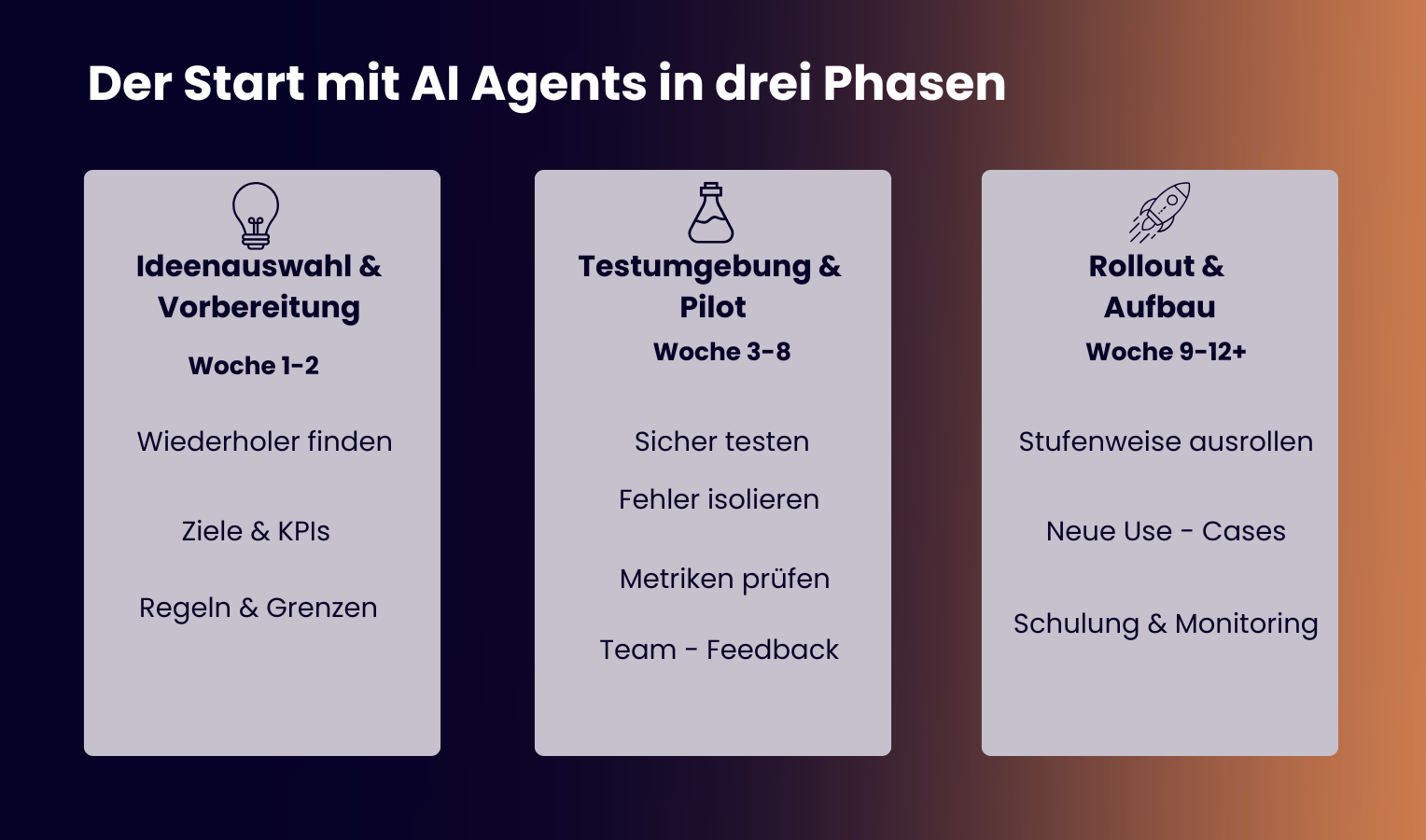
Phase 1 (weeks 1–2): idea selection & preparation
Identify suitable tasks: which processes repeat often and can be clearly defined? Set goals & success criteria (e.g. minutes saved per request). Define rules: which actions may the agent perform? When is human approval needed? Which systems are allowed?
Phase 2 (weeks 3–8): test environment & pilot
Set up a secure test environment where the agent takes on its first tasks – with no live risk yet. Collect metrics: time saved, error rates, acceptance. Involve your team, observe the processes and optimize iteratively.
Phase 3 (weeks 9–12+): rollout & expansion
Calibrate the agent for production. Launch officially and expand the scope step by step – under continuous monitoring. Identify new use cases, automate further tasks and train your team. That way, usage grows safely and measurably.
Success criteria: what really counts
An AI agent is a success when concrete metrics are achieved:
- Handling time: how much faster does the agent complete tasks?
- Error rate: how often were there follow-up questions, corrections or incidents?
- Acceptance rate: share of correctly automated cases vs. manual interventions.
- Customer satisfaction: ratings, CSAT/NPS, qualitative feedback.
- Cost per transaction: including API calls, storage, infrastructure.
- Rule violations: were limits exceeded? Were there wrong actions?
These metrics make progress visible, reveal optimization potential and prove the added value.
A realistic everyday example
A mid-sized online shop receives 1,500 service requests a month, around 30% of them returns. Everything used to be manual – checks, label creation, emails, ticket updates.
After introducing a returns agent, these steps are fully automated: order data is checked, labels created, customers informed and everything properly documented.
Result after eight weeks:
- less handling time
- higher customer satisfaction
The support team focuses on complex cases, and the error rate drops significantly. Shortly afterwards, the agent is extended to invoices, warranty cases and data updates.
Tips for a smooth rollout
- Start small: begin with a manageable use case.
- Clear rules: define precisely what the agent may do – and what not.
- Human in the loop: build in approvals for sensitive steps.
- Measure continuously: review KPIs regularly and fine-tune.
- Bring your team along: explain early, show the benefits, integrate feedback.
- Iterate: start, learn, optimize – then expand.
What to watch out for (managing risks consciously)
- Avoid misunderstandings: when in doubt, the agent should ask or pause.
- Limit actions: only allow predefined tasks and set hard limits.
- Documentation & logs: every action, every fallback, every error is traceable.
- Strict data protection: data minimization, encryption, access controls, deletion policies.
- Contingency plans ready: rollbacks, alerts, escalation paths.
Outlook: where AI agents are heading
The technology is developing rapidly: agents are becoming more autonomous while staying within clearly defined boundaries. Multi-agent systems work together on complex tasks, specialist agents take over functional areas, and long-term learning improves results over time.
For you, this means: if you start sensibly today, you'll have a strategic head start tomorrow. AI agents aren't hype – they're a tool for real change.
Conclusion: from idea to practical help
AI agents bring automation to where it has the most impact in service. They take on tasks that used to cost time, energy and room for error – and execute processes in seconds. With clear rules, a focused start and a phase of close monitoring, you minimize risks and make success visible quickly.
You don't have to automate entire departments right away – but get started. Every day an agent takes on tasks saves time, relieves teams and strengthens your service.