
TL;DR — The essentials in 30 seconds
- A chatbot answers written requests via website, app or messenger. A voice bot makes the same logic available by phone — via speech recognition (speech-to-text) and speech output (text-to-speech).
- Phone automation usually pays off from 800 to 1,000 calls a month — a lower threshold than for pure text automation, because calls are much more expensive per interaction than tickets.
- Voice bot and chatbot aren't an either-or. The most cost-effective solution uses one shared knowledge base for both channels instead of maintaining two separate systems.
- Providers like Seamly.AI come in exactly here: they give an existing chatbot a phone voice without duplicating the underlying logic.
Definition:
A voice bot is an AI system that answers phone calls automatically, converts spoken language into text (speech-to-text), understands the request and returns a suitable answer as synthetic speech (text-to-speech). Technically, it's often based on the same logic as a chatbot — just via the phone channel instead of text.
Many companies already use a chatbot and ask themselves next: is it worth automating the phone hotline too? The answer depends on three factors: your call volume, the share of standardizable call reasons and whether you think of voice as a standalone system or as an extension of your existing chatbot. This article puts both technologies into context, provides a threshold formula for phone automation and shows how text and voice channels complement each other.
What's the difference between a voice bot and a chatbot?
The key difference lies in the channel, not the intelligence: a chatbot processes text directly, while a voice bot also needs a speech recognition and speech output layer before the same logic can kick in.
With a chatbot, the customer types their question, the system recognizes the intent and replies in text — in real time, with no latency from speech processing. With a voice bot, there's an extra step before and after: automatic speech recognition (ASR) converts what's spoken into text, and at the end text-to-speech (TTS) turns the answer back into speech. These two extra steps explain why voice bots tend to need a little more response time than chatbots, and why speech recognition errors — for example with dialects, background noise or poor connection quality — are an additional source of error that doesn't exist with text.
In terms of content, a voice bot can basically cover the same topics as a chatbot: opening hours, order status, billing questions, appointment booking. What matters is whether the knowledge base is built separately or whether both channels access the same logic. The latter avoids duplicate maintenance and inconsistent answers between phone and chat.
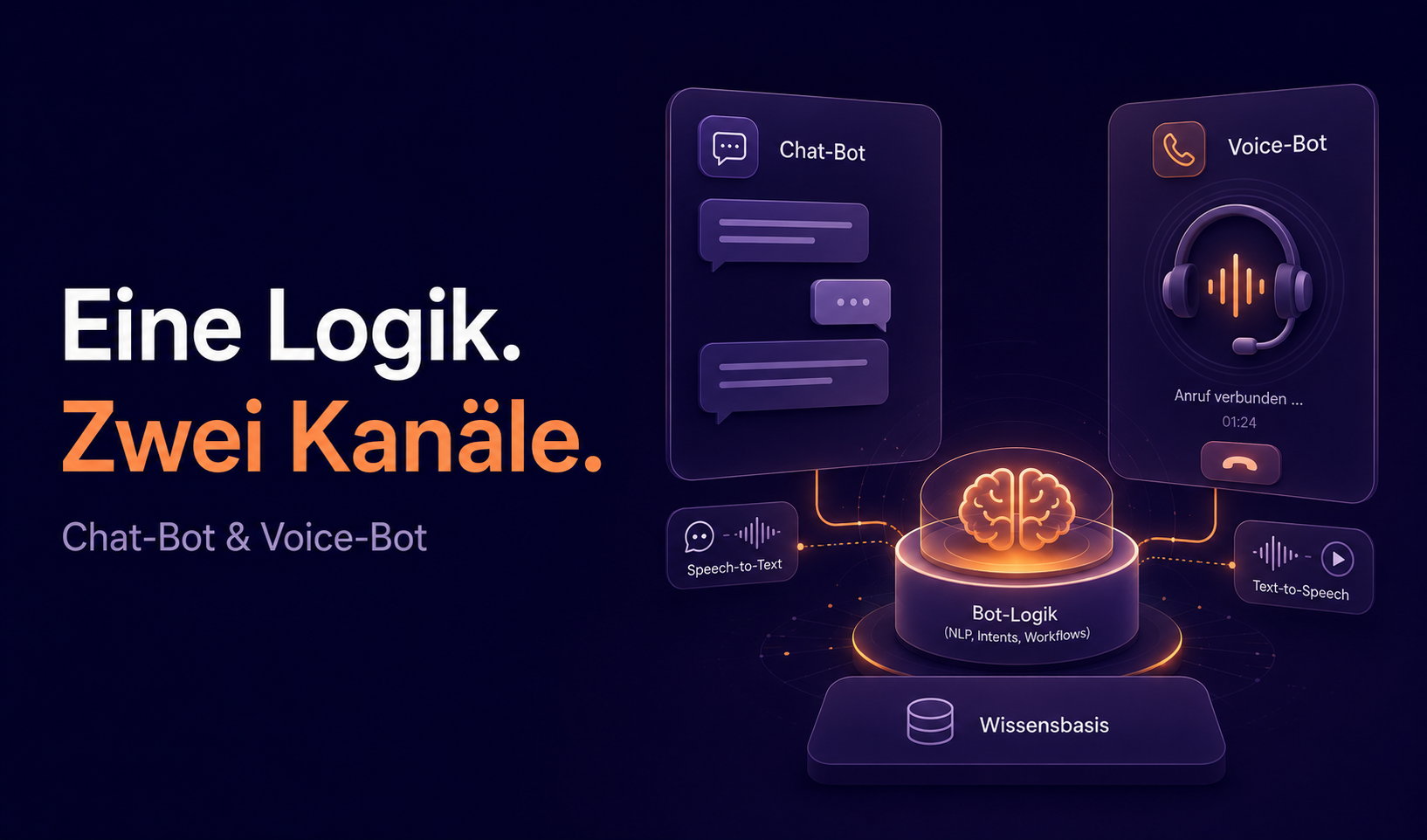
The most obvious difference is the channel: a chatbot runs via website, app or messenger, a voice bot via the phone network, i.e. landline and mobile. Technically, the chatbot is based on NLP and intent recognition, while the voice bot adds an ASR component for speech-to-text and a TTS component for text-to-speech to the same NLP base. On response latency, the chatbot has the edge because it replies without extra speech processing, while the voice bot takes a little longer due to the two additional processing steps. The sources of error differ too: a chatbot mainly struggles with typos and ambiguity, a voice bot additionally with pronunciation, dialect and background noise. The use cases overlap strongly — FAQs, order status and appointment booking work on both — and the voice bot also covers calls from customers without internet access. Setup effort is usually low to medium for a chatbot and medium for a voice bot, depending on the phone system integration. Cost per interaction is low for the chatbot and somewhat higher for the voice bot, but in both cases well below the cost of a live agent.
The following diagram compares the technical processing path of both channels side by side.
Which call reasons can be automated?
Standardized, recurring call reasons with a clearly defined answer can be automated most reliably — complex, emotional or highly case-specific issues remain a job for human staff in 2026 too.
Well suited to voice automation are calls about opening hours and location information, order and delivery status, simple appointment booking and rescheduling, invoice and payment status, and frequent FAQs such as return conditions or warranty questions. In many industries, these call reasons make up a significant share of total volume because they recur and have a clear, data-based answer.
Less suitable are complaints that need a lot of explanation, calls with a strong emotional component (complaints, cancellations out of dissatisfaction) and requests that require checking several systems at once or individual negotiation. Here, a handover mechanism to a human agent — including conversation context — is crucial for customer satisfaction. Which standard requests can be automated in e-commerce is shown in the melibo article on Shopware chatbots, using order status, returns and product availability as examples.
From what call volume does a voice bot pay off?
A voice bot pays off as soon as the staff costs saved per automated call exceed the running costs of the voice infrastructure — in practice, this point is usually around 800 to 1,000 calls a month.
The formula follows the same logic as ticket automation in the text channel, with two important adjustments: calls take longer on average than writing an email reply, and the automation rate for voice is typically somewhat lower than for text, because speech recognition is more error-prone than written language.
Monthly savings = calls/month × automation rate × (avg. call duration in h × hourly rate)
Example: with 1,000 calls a month, an automation rate of 30% (set more cautiously than for text bots, as calls tend to cover more complex topics), an average call duration of 4 minutes and an hourly rate of €45, monthly savings come to around €900. At higher volumes — say 3,000 calls a month in a customer service center with seasonal peaks — savings rise to over €2,700 a month, often much more if peaks can be absorbed without extra staff.
Below around 500 calls a month, standalone voice infrastructure usually doesn't pay off yet. Here, a well-maintained chatbot with a clearly visible phone number for more complex cases is often the more cost-effective solution — call volume drops anyway when customers can resolve their standard questions via chat.
Chat first or voice first? How both channels work together
Most companies should think of voice not as a replacement but as an extension of their existing chatbot — both channels work best when they share the same knowledge base and conversation logic.
In practice, this means: a company first builds a chatbot based on its most frequent customer requests, validates the answers over several weeks and then transfers this proven logic to the phone channel. The advantage of this order: you test and correct intents, FAQ content and escalation rules in the lower-risk text channel first, before they go live on the phone, where errors are more immediate and more frustrating for the caller.
Seamless handover between channels is important: if a customer first asked a question in chat and calls later, the voice bot should ideally know the same context — instead of the customer having to explain their issue from scratch again. This context continuity between chat, voice and live agent is one of the biggest differences between a well-thought-out omnichannel strategy and two isolated solutions.
What does a voice bot cost compared to a chatbot?
Voice automation adds running infrastructure costs compared to a pure chatbot, because phone connectivity, speech recognition and speech output are additional components that are operated separately and often billed per call or per minute.
At its core, a chatbot needs a knowledge base, conversation logic and a connection to the website or messenger. A voice bot also needs phone connectivity via SIP or PSTN, a speech-to-text engine, a text-to-speech engine and usually local phone numbers for the respective markets. Depending on the provider, these components are billed individually — STT, TTS, recording, transcription and insights as separate items — or bundled into a single price per call. For budget planning, the second option is much easier to calculate, because costs don't grow unpredictably as calls get longer.
Setting up a voice extension for an existing chatbot usually takes around 4 weeks with specialized providers, since the actual conversation logic already exists and only needs to be connected to the phone channel — much less effort than building a completely new system from scratch.
The GDPR and voice data — what's different with voice AI compared to text?
Besides the conversation content, phone calls can also contain biometric voice characteristics, which is why voice solutions require extra care in the GDPR review compared to pure text chatbots.
In principle, voice bots are also subject to the GDPR requirement to conclude a data processing agreement (DPA) under Art. 28 GDPR as soon as personal data is processed — which is the case in almost every call. For voice recording and analysis, Art. 9 GDPR, which governs special categories of personal data, also becomes relevant; pure voice recognition for identification can count as biometric processing depending on how it's set up and then requires a separate legal basis. From August 2, 2026, the EU AI Act also requires transparency: callers must be able to recognize that they're speaking to an AI system, for example through an announcement at the start of the call (Art. 50 EU AI Act, Regulation 2024/1689). How to implement this labeling obligation for voicebots, chatbots and AI-generated emails is explained in the melibo article on the EU AI Act in customer service with an 8-point checklist.
For companies in the DACH region, it's advisable to ask specifically about hosting location, retention periods for recordings and the exact terms of the DPA when choosing a provider — standards you should already know from your chatbot provider. Germany's Federal Office for Information Security provides guidance on hosting location and cloud sovereignty with its C5 criteria catalog. Read more about GDPR-compliant text chatbots in the melibo article: using chatbots in your company in a GDPR-compliant way.
melibo and Seamly.AI: text and voice channels from one knowledge base
melibo covers the text channel — chat on website, app and messenger, connected to Shopware, Zendesk, Freshdesk and other systems. For companies that also want to automate the phone channel, melibo partners with Seamly.AI, a provider that makes existing chatbot platforms available by phone via a so-called voicification layer.
The technical principle: Seamly.AI doesn't build a separate second bot with its own logic but connects the existing melibo knowledge base to the phone network via SIP or PSTN. Incoming calls are converted into text via speech-to-text, forwarded to the melibo platform, and the answer is spoken back via text-to-speech. In practice, this means one knowledge base, one maintenance effort, two channels — instead of a completely separate voice system that would have to be kept up to date in parallel. The connection works without changes to existing phone systems, as Seamly.AI provides and operates the infrastructure layer (SIP/PSTN, speech recognition, speech output) itself.
The following diagram shows how a call and a chat message reach the same knowledge base.
Frequently asked questions (FAQ)
Is a voice bot the same as a chatbot, just with speech?
Essentially yes: both are often based on the same intent recognition and knowledge base. The difference lies in the extra technical layers of speech-to-text and text-to-speech that a voice bot needs before and after the actual answer logic, and in a somewhat lower realistic automation rate, since spoken language is more error-prone to process than written text.
From how many calls a month does phone automation pay off?
As a guideline, the threshold is around 800 to 1,000 calls a month — lower than for text tickets, because calls are more expensive to handle manually on average. Below around 500 calls a month, standalone voice infrastructure usually doesn't pay off yet.
Can I simply extend my existing chatbot with voice, or do I need a completely new system?
An extension is usually enough. Providers specializing in voicification connect an existing chatbot platform to the landline or mobile network via a phone connection, without duplicating the underlying knowledge base. This reduces both setup and ongoing maintenance compared to two separate systems.
Can voice AI be used in a GDPR-compliant way by German companies?
Yes, provided certain requirements are met: a valid DPA with the provider, a clear legal basis for any biometric voice processing under Art. 9 GDPR and a transparency announcement under Art. 50 EU AI Act informing callers about the AI interaction. More on implementing the labeling obligation: EU AI Act in customer service. Also pay attention to where the voice data is hosted.
Which call reasons should I automate first?
Start with the most frequent, most clearly standardizable issues — typically opening hours, order or delivery status and simple appointment requests. These topics have a clear, data-based answer and quickly deliver measurable relief before you add more complex use cases.
Free strategy session
Now you know when voice pays off.
Let's check together what fits your support.
In a free 30-minute call, we'll look at your chat and call volume and show you whether and how your chatbot can be extended with a phone voice — no sales pressure.
Book a free call →Conclusion
Voice bots and chatbots aren't competitors but stages on the same path: if you already run a chatbot, consider phone automation as a logical extension once call volume reaches around 800 a month — below that, extending your existing chat channel usually pays off first. What matters isn't which channel is better, but that both work from the same knowledge base, so customers get consistent answers regardless of how they get in touch and companies only need one maintenance loop instead of two.