TL;DR — The essentials in 30 seconds
- What is an AI agent for Zendesk? An AI system that automatically understands, answers and escalates tickets, directly via the Zendesk API, without manual routing.
- Top providers in 2026: melibo, Ada, Fin (Intercom), Cognigy, ChatArmin and Tidio. The differences lie in GDPR compliance, integration depth and German-language skills.
- Decision criterion no. 1: native API integration vs. middleware. This determines onboarding effort and stability.
- GDPR requirement: every provider that processes personal Zendesk data must provide a data processing agreement (DPA). Not all of them do so reliably.
- Break-even: from around 800 to 1,200 Zendesk tickets a month, an AI agent pays off, depending on hourly rate and automation rate.
Definition
An AI agent for Zendesk is AI-powered software that integrates with your support system via the Zendesk API, classifies incoming tickets, answers them on its own or escalates them to the right agent, drawing on the knowledge base, order data and ticket history — without anyone having to step in manually.
If you use Zendesk as your helpdesk, you'll hit the same problems at a few hundred tickets a month at the latest: response times rise, agents answer the same questions over and over, and scaling automatically means more staff. AI agents solve this directly in your existing Zendesk setup, without switching systems. This comparison shows which provider really delivers in 2026.
What makes an AI agent different from a classic chatbot in Zendesk?
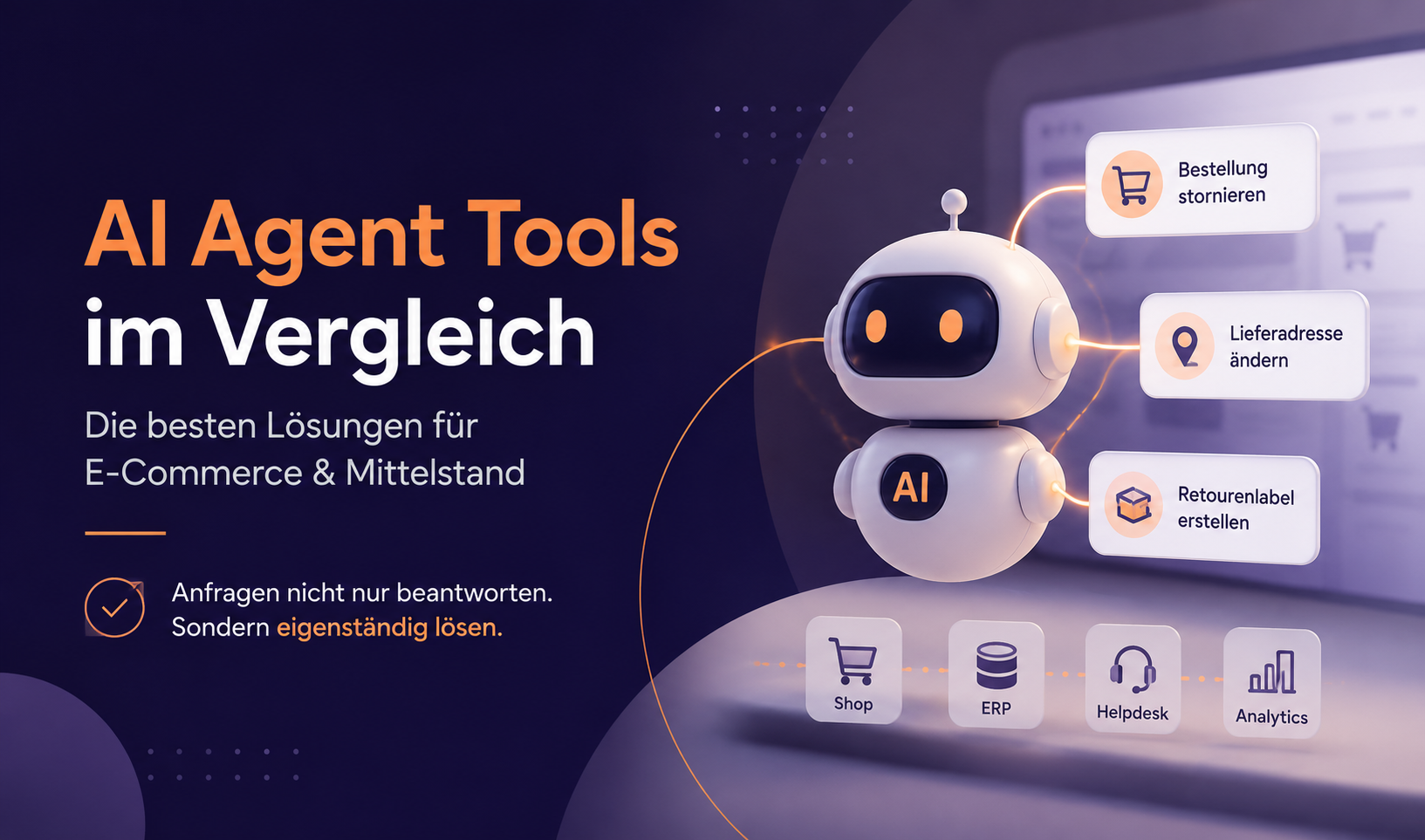
A classic chatbot answers questions based on fixed rules and decision trees. An AI agent goes further: it understands natural language, draws on context from previous tickets and carries out multi-step actions, for example checking order status, closing the ticket and automatically sending a confirmation. It hands issues that have become complex over to a human agent in a structured way.
In Zendesk, this specifically means: the AI agent works directly in your ticket interface, creates tickets, fills in fields, tags and closes them. A rule-based bot doesn't. What this means operationally and which processes to automate first is covered in a separate practical article with concrete Zendesk use cases.
For the ROI calculation, the distinction between two levels of automation is crucial. Agent Assist suggests replies to your Zendesk agents, summarizes ticket histories or fills in macros. The human decides and sends. Time saved: 2 to 4 minutes per ticket. A fully automated AI agent (agentic AI) handles and closes tickets on its own, without human intervention. Suitable for standard requests such as order status, FAQs and password resets. Realistic automation rate: 35 to 45 percent of all incoming Zendesk tickets. Combined, over 60 percent is achievable.
These criteria decide the choice
Before you compare individual providers, you need a clear framework. The first and most important criterion is native Zendesk integration: does the AI agent work directly via the official Zendesk API, or does it need middleware like Zapier, Make or custom webhooks? Native integrations are more stable, faster and need less maintenance. Middleware solutions often break with Zendesk updates and create hidden maintenance costs.
The second criterion is GDPR compliance and hosting location. Zendesk tickets contain personal data: customer names, email addresses and order information. You need a DPA, and the provider must be transparent about where data is processed. Hosting outside the EU is a dealbreaker for many DACH companies, especially since the EU AI Act began coming into force in stages from 2024.
The third criterion is the German-language skills of the language model. Many providers are optimized for English. What matters for DACH customer service: does the model understand regional phrasing, umlauts and industry jargon? Models like Mistral or Llama can be stronger in German than GPT-4o. Test this in a pilot with real tickets, not constructed examples.
The fourth criterion is onboarding effort. Solutions with preconfigured Zendesk connectors go live within 4 weeks. Custom API projects take 3 to 6 months. The fifth criterion is the cost structure: billed per ticket, per month or per seat. At high volumes, this makes a significant difference.
The best AI agents for Zendesk in 2026 compared
melibo
hosts exclusively in Germany and offers a native Zendesk integration without middleware. The AI agent creates tickets, updates status fields, tags and closes requests directly in Zendesk. A special feature in the DACH market: native integrations for Shopware, Xentral and GREYHOUND also enable e-commerce workflows that resolve order data from the shop directly in Zendesk tickets. The DPA is included as standard, no renegotiation needed. Pricing on request, onboarding in 4 weeks. Suitable for SMEs and enterprises in e-commerce and the B2B mid-market. How the Zendesk connection works technically and which data the AI agent retrieves in real time is explained in detail on the melibo Zendesk integration page.
Ada
is a Canadian provider with a strong Zendesk integration and an established platform for enterprise customers. Hosting in the US or EU on request; a DPA is available but not included in onboarding as standard. German-language skills are good but not optimized for DACH. Onboarding: 4 to 8 weeks, starting at around $2,500 a month. Ada targets companies with around 10,000 tickets a month or more.
Fin (Intercom)
is Intercom's AI agent and one of the fastest options to get started, primarily for existing Intercom customers. The Zendesk integration is native, and billing is per resolved ticket from around $0.99. Fin is optimized for English-language support; German works, but regional quality varies. GDPR compliance is partial, with mixed hosting in the US and EU. Onboarding: 1 to 2 weeks.
Cognigy
is a German enterprise company with a very strong NLU engine and excellent German-language skills. Hosting in Germany is possible, and a DPA is available as standard. The Zendesk integration is API-based and requires 6 to 12 weeks of configuration. Cognigy suits corporations with complex process requirements, less so SMEs needing a fast ROI. Enterprise pricing model.
ChatArmin
is an Austrian provider focused on the DACH market with a WhatsApp-first strategy, but also with a Zendesk connection. Hosting in the EU, DPA available as standard. The Zendesk integration is API-based; onboarding: 3 to 6 weeks. A good fit for companies with a high share of WhatsApp and messaging tickets. Pricing on request.
Tidio
is a low-cost entry option for smaller companies from around €29 a month. The Zendesk connection runs via webhooks and middleware, not natively — so setup is quick (1 to 2 weeks), but it's less stable at high volumes. Hosting in the EU (Ireland), GDPR coverage partial. Tidio works as a first automation tool but hits its limits with complex Zendesk workflows.
Setting up a Zendesk AI agent: how the integration works
With providers that offer preconfigured Zendesk connectors, steps 1 to 3 usually take under 30 minutes. The difference from a self-built setup: no IT project, just configuration. melibo states that its average ramp-up time is 30 business days from contract signing to go-live, based on more than 170 projects. The Fahrrad XXL success story shows what this looked like in practice: the bike retailer replaced its Zendesk chatbot with melibo and was able to automate requests much faster ahead of peak season.
ROI calculation: when does an AI agent pay off in Zendesk?
* AI agent license costs for mid-sized DACH companies: typically €500–2,500/month depending on volume and provider. One-off setup costs not included.
The break-even formula for Zendesk setups is:
Monthly savings = tickets/month × automation rate × (handling time in h × hourly rate)
Example: 1,000 tickets, 40% automation, 6 minutes on average, €45/hour gives savings of €1,800 a month. With a monthly license of €500 to €1,000, the ROI is positive from the very first month. For Zendesk-specific calculations, also factor in the effort for macro maintenance and knowledge base updates, which the AI agent reduces too. Industry benchmarks for e-commerce and B2B and a step-by-step explanation of the formula can be found in the guide to 60% automation in customer service.
The GDPR and Zendesk: what to watch for in 2026
Zendesk stores customer data, ticket histories and communication content — all personal data under the GDPR. As soon as an AI agent processes this data, the following requirements apply.
Data processing agreement (DPA): check whether the DPA is supplied as standard or only on request. Providers that don't offer it proactively are a risk in the DACH market.
Subprocessor transparency: which language model processes the data — GPT-4o, Mistral or Llama? Where is it hosted? Standard contractual clauses (SCCs) alone aren't enough for many DACH companies.
EU AI Act transparency obligation (Art. 50, Regulation (EU) 2024/1689): customers must be able to recognize that they're interacting with an AI system. A notice in the Zendesk chat widget or in the automated reply has been mandatory since 2025. The full legal text is available in the European Commission's EUR-Lex database.
Hallucination protection via RAG: AI models that only access your own knowledge data (retrieval-augmented generation) are more reliable than models with unfiltered internet access. Ask providers directly about their architecture.
Providers like melibo, which host in Germany and keep all data flows within the EU, make GDPR compliance much easier. The DPA is included as standard, and subprocessor lists are provided immediately on request.
Which Zendesk plans are supported?
Most AI agent providers require at least the Zendesk Suite Professional plan, since it gives access to the full Zendesk API, webhooks and Guide (knowledge base). The Suite Team plan offers limited API access and usually isn't sufficient for full AI agent integrations.
Check before buying: which API endpoints does the provider use, and are they included in your current Zendesk plan? Zendesk Suite Enterprise adds sandbox environments for testing before go-live, which is useful for larger rollouts. You'll find the current plan overview with all API access levels directly at Zendesk.
Free potential analysis
Now you know which AI agent fits Zendesk.
Let's work out together what it saves you.
In a free 30-minute call, we'll analyze your Zendesk setup and ticket volume and show you which integration level is right for your company — no sales pressure, with concrete numbers.
Frequently asked questions (FAQ)
Which AI agent works best with Zendesk?
That depends on your requirements. For DACH companies focused on the GDPR and native Zendesk integration, melibo and Cognigy are the strongest options. For a quick start on a small budget, Fin (Intercom) is a possible starting point, though with compromises on GDPR compliance and German-language skills. The decision depends on ticket volume, the share of German-language requests and the integration depth you need.
How long does it take to integrate an AI agent into Zendesk?
With native integrations such as melibo and Fin, the technical connection takes under 30 minutes. Until productive go-live, including knowledge base, automation rules and test phase, expect around 4 weeks. API-based solutions like Cognigy and ChatArmin need 6 to 12 weeks because more configuration work is involved.
Does an AI agent for Zendesk have to be GDPR-compliant?
Yes, absolutely. Zendesk tickets contain personal data: customer names, email addresses, order information and communication content. Every AI agent that processes this data needs a DPA. In addition, since 2025 the EU AI Act (Art. 50, Regulation 2024/1689) has required that customers can recognize they're communicating with an AI system. The BSI and DACH supervisory authorities prefer hosting within the EU.
Which Zendesk plans are supported for AI agents?
Full AI agent integrations require at least Zendesk Suite Professional, including full API access, webhooks and Zendesk Guide. Suite Team isn't sufficient for most providers. Suite Enterprise also offers sandbox environments for complex rollouts.
How much does an AI agent for Zendesk cost?
The range is wide: Tidio starts at €29/month, Fin (Intercom) charges around $0.99 per resolved ticket, Ada and Cognigy typically start at $2,500 to $5,000/month. melibo and ChatArmin work with individual quotes depending on volume and integration scope. What matters isn't the list price but the price per resolved ticket. The quickest way to find it is a free potential analysis, which calculates the ticket volume and automation level of your Zendesk setup in concrete terms.
Can an AI agent in Zendesk also answer in German?
Yes, all the providers mentioned support German. But the quality differs considerably. Providers developed for the DACH market – melibo, Cognigy and ChatArmin – understand regional phrasing, umlauts and industry-specific language more reliably than models optimized for English. Always test with real tickets from your Zendesk system during evaluation.