
Introduction
In 2025, chatbots are firmly established in digital communication. They give users fast, automated answers to questions, guide them through processes and take the load off teams in support, sales and marketing. Whether as a smart assistant in an online store, an HR bot on the intranet or a lead qualifier on landing pages – chatbots are versatile and deliver measurable value.
While the technology keeps evolving, the term "chatbot" remains central for users and companies. In this article, we explain what chatbots are, how they work, what benefits they offer and where they're used. At the end, we also take a quick look at their technological successor: AI agents.
What is a chatbot?
A chatbot is a digital system that communicates with people automatically – via text or voice. Its goal is to answer questions, provide information or perform actions without a human having to step in.
Chatbots are used in many areas: in customer support they help with order inquiries, in e-commerce they advise on product choice or availability, and in HR they answer applicants' questions or clarify internal processes.
Chatbots are especially popular on websites, in messenger apps such as WhatsApp or Facebook Messenger, in mobile apps and increasingly in internal tools too.
How do chatbots work?
Modern chatbots consist of several core components:
- Natural language processing (NLP): The bot analyzes the user's natural-language input and recognizes the underlying intent (e.g. "I haven't received my order yet").
- Intent & entity recognition: The chatbot recognizes what the user wants and which additional information matters (e.g. order number, product name).
- Dialog management: Based on defined rules or AI models, the bot decides how to continue the dialog.
- Knowledge base: Many chatbots draw on stored content, FAQs or product databases.
- System integration: Via interfaces (APIs), the bot can access systems such as CRM, ERP or helpdesks to retrieve or update data.
- Answer generation: Depending on the setup, the chatbot answers with prepared text snippets or generates context-dependent answers.
One important trend is RAG (retrieval-augmented generation): the chatbot first searches approved sources (e.g. PDF documents or wikis) to generate well-founded answers – ideal for support or products that need explaining.
Types of chatbots
Rule-based chatbots
These bots work on the "if X, then Y" principle. They follow fixed decision trees and are especially suited to standardized processes such as FAQs, status queries or scheduling appointments. They're quick to implement, easy to control and very reliable – but not very flexible with unexpected input.
AI-powered chatbots
These bots use artificial intelligence to respond more freely to user input. They recognize more complex intents, learn from conversations and can give meaningful answers even to unstructured or ambiguous phrasing. They're suited to advice, complex processes or applications with variable user questions.
Hybrid chatbots
Combining both approaches is especially powerful: rule-based structures ensure safety and consistency, while AI modules provide flexibility and more natural dialogs. Hybrid bots are now standard in many professional setups.
Benefits of chatbots
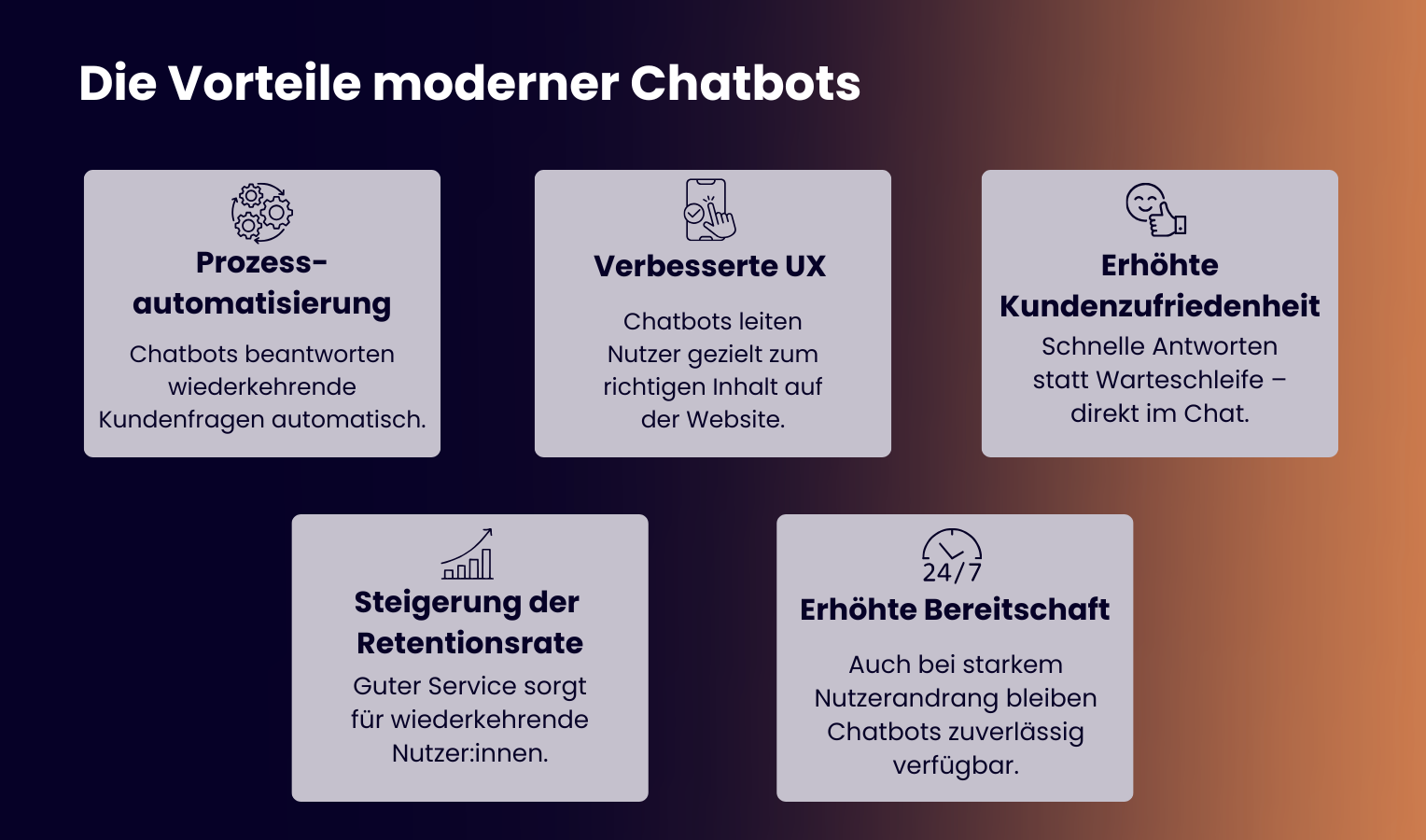
Time and cost savings
Chatbots handle recurring tasks automatically – from password resets to shipment tracking. This reduces the workload for human employees and saves resources.
24/7 availability
A chatbot is always reachable – even at night, on weekends or on public holidays. That's a big advantage, especially in customer service.
Scalability
A chatbot can interact with hundreds of users at once – without waiting times or loss of quality.
Better user experience
With fast, direct answers and easy handling, chatbots significantly improve the user experience. No more lengthy searching – help comes right in the conversation.
Data collection and insights
Chatbots log all interactions. Companies can derive valuable insights into customer questions, problems and interests from them – and improve their content or services in a targeted way.
Typical chatbot use cases
Customer service & support
Chatbots answer frequent questions, guide users through processes such as returns or complaints and offer self-service features right in the chat.
E-commerce
Product advice, availability checks, sizing advice or direct support at checkout – chatbots increase the conversion rate and lower abandonment rates.
Marketing
Interactive quizzes, lead qualification, newsletter sign-ups or discount campaigns: chatbots can be playful and informative at the same time – with clear targeting.
HR & recruiting
Chatbots provide information about open positions, answer applicants' questions, schedule interviews or help onboard new employees.
Internal applications
Chatbots can also help on the intranet – for example with IT requests, finding internal policies or automated form processing.
Limits and challenges
Despite all their benefits, chatbots also have limits:
- Comprehension problems: The chatbot can be overwhelmed, especially by complex, ambiguous questions.
- Limited context: Classic bots often struggle to keep the conversation context across several steps.
- Maintenance effort: Content, rules and systems must be updated regularly.
- Data protection: Strict GDPR requirements apply to personal data – this calls for transparency, security and control.
- Acceptance: Some users still prefer direct contact with real people – so chatbots must be used sensitively.
A quick look into the future: AI agents
Although this article focuses on chatbots, there's an exciting further development: AI agents. They go beyond the classic chatbot function by not only communicating but also planning and acting on their own. AI agents use multiple tools, perform actions and interact in a context-aware way across different modalities.
They're more powerful but also more complex – and far from useful everywhere yet. For many companies, chatbots remain the most efficient way to automate customer communication.
Conclusion
Chatbots are here to stay. They automate communication, improve the user experience and enable efficient processes – in support, marketing, sales and beyond.
Despite technological progress and the emergence of AI agents, the term "chatbot" remains relevant – in practice, in how users understand it and from an SEO perspective. If you deploy a powerful chatbot today, you lay the foundation for future intelligent assistants – and already benefit from more efficiency, satisfaction and scalability.