TL;DR – the key points in 30 seconds
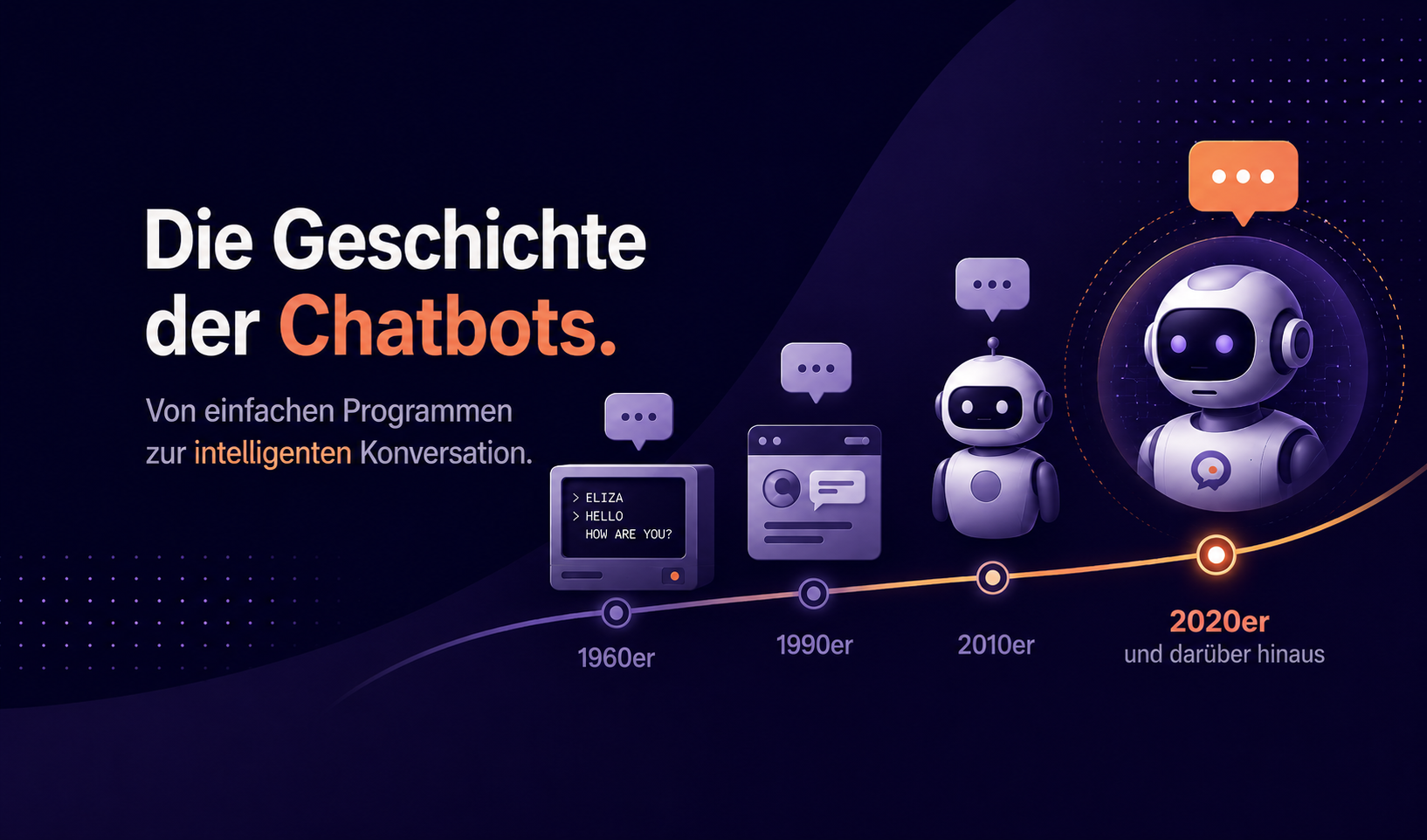
- First chatbot: ELIZA, developed in 1966 by Joseph Weizenbaum at MIT, is considered the first chatbot in history – a rule-based program that imitated a psychotherapist.
- Three generations: rule-based bots (1966–2015) → NLP-based chatbots (2016–2021) → LLM-based AI agents (2022–today).
- Turning point 2022: ChatGPT brought large language models (LLMs) to the masses. Since then, chatbots can do more than answer – they can plan, research and take actions.
- 2026: The term "chatbot" is increasingly giving way to "AI agent". Modern systems resolve support tickets fully automatically, access back-end systems and act independently – without a rigid rule set.
Definition · Chatbot
A chatbot is a software program that understands natural language and automatically responds to text input or speech. Early chatbots worked with fixed rule sets; modern systems use large language models (LLMs) and can independently access databases, APIs and external services.
The history of chatbots is the history of the question of whether machines can think. Alan Turing asked that question in 1950 – and it still hasn't been fully answered. What has changed over the past 75 years: the systems we build to answer it have become exponentially more powerful. This article shows the most important milestones, explains the differences between chatbot generations and puts into perspective where we really stand in 2026.
1950: Alan Turing and the question of whether machines can think
The root of every chatbot discussion lies in a 1950 paper by British mathematician Alan Turing: "Computing Machinery and Intelligence". In it, Turing asked: "Can machines think?" – and formulated an operational test to examine the question empirically.
The Turing test (also called the "imitation game") works like this: a human interrogator communicates in writing with a human and a machine at the same time. If they can't reliably tell at the end which is the human and which the machine, the machine has passed the test. The test doesn't measure intelligence – it measures the ability to convincingly imitate human language. That's an important distinction that still sparks debate today.
Turing's idea laid the conceptual foundation for every system that followed.
1966–1972: ELIZA and PARRY – the first chatbots
The first chatbot to be seriously discussed was developed in 1966 by MIT professor Joseph Weizenbaum: ELIZA. The program imitated a psychotherapist and worked on a simple principle: it recognized keywords in the user's input and turned them into follow-up questions – not real answers, just contextually plausible counter-questions.
What surprised Weizenbaum: many users confided real worries to ELIZA and asked for more time with the program. He called this phenomenon the "ELIZA effect" – people's tendency to attribute human qualities to a computer system, even when it has none. The ELIZA effect is still relevant in chatbot design today, especially when it comes to designing personality and empathy in AI agents.
In 1972, psychiatrist Kenneth Colby developed the chatbot PARRY – also rule-based, but with a simulated personality: PARRY portrayed a paranoid schizophrenic. In blind tests, experienced psychiatrists couldn't reliably tell PARRY apart from real patients. PARRY thus passed a limited Turing test – something ELIZA hadn't managed.
1980s and 1990s: the AI winter and the first commercial bots
In the 1980s, interest in artificial intelligence cooled noticeably. Research funding was cut and expectations had outpaced reality – a phase researchers now call the "AI winter". There were two AI winters in total: one in the late 1970s, a second from the late 1980s to the early 1990s.
Even so, the first commercial applications emerged during this time. The program Racter (1984) generated English prose that was even published as a book in 1984 – not a chatbot in today's sense, but early evidence of machine-generated text. Text-based adventure games such as "Mystery House" or "Zork" used simplified language processing to interpret commands – the first commercial uses of rule-based language processing.
The term "chatbot" was coined in the 1990s by computer scientist Michael Mauldin, who developed the chatbot JULIA for multi-user dungeons (MUDs) in 1994. In 1995 came Richard Wallace's ALICE (Artificial Linguistic Internet Computer Entity) – the first chatbot to work on an open knowledge base, and it could hold surprisingly flexible conversations for its time. ALICE won the Loebner Prize three times, an annual competition in which chatbots compete against each other in the Turing test.
2000–2015: chatbots on the web – SmarterChild, Siri and the rise of voice assistants
With the rise of instant messaging in the early 2000s, chatbots reached the mass market for the first time. SmarterChild (2001), developed by ActiveBuddy, was integrated into AOL Instant Messenger and MSN Messenger and had over 30 million users at its peak. SmarterChild answered questions about weather, news and sports – rule-based, but impressively fast and accessible for the time.
In the same period, companies began using chatbots for customer service. The first commercial solutions were expensive, hard to configure and often frustrating – but they marked the beginning of a new era.
The next milestone: in 2011, Apple introduced Siri – the first voice assistant on a mainstream smartphone. Siri combined speech recognition with rule-based intent interpretation. It was soon followed by Google Now (2012) and Amazon Alexa (2014), which brought the voice assistant concept into millions of living rooms.
Also in 2011, IBM Watson beat two of the most successful human players in history on the US quiz show Jeopardy!. Watson proved that machines could beat humans in certain knowledge domains – a media event that changed the public perception of AI for good.
2016–2021: NLP and machine learning – chatbots learn to understand
From 2016 on, the technical basis of chatbots changed fundamentally. Instead of static rule sets, natural language processing (NLP) and machine learning came into play. Chatbots were trained to recognize the intent behind a user's question – not just match keywords.
The decisive breakthrough at model level: in 2017, Google published the Transformer architecture paper "Attention Is All You Need" – the technical foundation for all modern language models. In 2018 came BERT (Bidirectional Encoder Representations from Transformers), also from Google, which improved language processing considerably once again.
In this phase, the first truly useful enterprise chatbots for customer service emerged: they could classify intents, extract entities (order number, date, product name) and hold dialogs over several conversation turns. Integrations into helpdesk systems such as Zendesk or Freshdesk became possible.
At the same time, the limits became visible: as soon as requests got complex or ambiguous, these systems failed. They couldn't learn new topics without being retrained and quickly seemed unnatural or helpless on edge topics.
2022: ChatGPT and the LLM revolution
In November 2022, OpenAI released ChatGPT — and within five days a million users had signed up. ChatGPT is based on GPT-3.5, a large language model (LLM) pre-trained on huge amounts of text. For the first time, a language model that could hold natural, contextually coherent conversations on almost any topic was accessible to everyone.
What makes LLMs fundamentally different from all their predecessors:
No rigid rule set. LLMs generate answers probabilistically based on learned language patterns – they aren't limited to predefined intent categories.
Context understanding across long texts. Modern LLMs such as GPT-4o, Mistral Large or Claude process thousands of words as context – and can draw coherent conclusions from it.
Generalization. A single model can answer customer questions, write code, create summaries and translate documents – without a separate model having to be trained for each task.
The downside: LLMs hallucinate – they invent plausible-sounding but factually wrong information. For business use, that's a serious problem. The solution is called retrieval-augmented generation (RAG): the model draws exclusively on its own curated knowledge base before answering. That produces factually reliable answers without the risks of uncontrolled internet access.
2023 and 2024 brought more models: GPT-4o (OpenAI), Gemini (Google), Claude (Anthropic), Mistral (Mistral AI) and Llama (Meta) – all more powerful, faster and cheaper to use than their predecessors.
2025–2026: from chatbots to AI agents
In 2026, many companies are replacing the term "chatbot" with "AI agent" – and it's more than a rebrand.
A classic chatbot answers. An AI agent acts. It can plan several steps, query external systems (order database, inventory, CRM), make decisions and take actions – for example cancel an order, update an address or close a support ticket. The concept is called agentic AI: AI systems that pursue goals autonomously without needing human input for every step.
According to Gartner, by 2028 around 33% of all enterprise applications will include agentic AI features – up from less than 1% in 2024. In customer service, that means AI agents fully take over first-level support, escalate to human agents in a targeted way and learn from every closed ticket.
For the DACH market, two regulatory frameworks also shape the chatbot landscape in 2026:
Since August 2025, the EU AI Act (Regulation 2024/1689) requires that users can recognize when they're interacting with an AI system – a notice in the chat interface is mandatory (Art. 52 EU AI Act). The EU AI Act classifies customer service chatbots as limited-risk systems, but requires transparency and clear limits on use.
The GDPR obliges providers to process personal customer data only on the basis of a data processing agreement (DPA). Customer chat data must not be used to train external models. Providers such as melibo, which host in Germany and keep all data flows within the EU, considerably reduce the compliance effort for companies. Learn more: GDPR-compliant AI chatbots: what companies need to know.
Three chatbot generations compared
The development can be divided into three clearly distinct generations – with a fourth stage that began in 2022.
Generation 1: rule-based chatbots (1966–approx. 2015) Rule-based chatbots answer based on fixed if-then logic. They recognize keywords and map them to predefined answers. They can't learn new topics unless a developer manually extends the rule set. Strengths: predictable, cheap. Weaknesses: rigid, no understanding of context, poor user experience when the conversation deviates from the expected flow. Typical use: simple FAQ bots, phone IVR systems.
Generation 2: NLP-based chatbots (approx. 2016–2021) NLP-based chatbots train intent classifiers on real conversation data. They can sort user questions into categories and extract entities – even when the wording varies. They need enough training data per intent and fail on unknown topics. Strengths: more flexible than rule-based systems, scalable for defined topic areas. Weaknesses: laborious training, poor performance on long or complex requests. Typical use: customer service chatbots with defined topic areas.
Generation 3: LLM-based chatbots and AI agents (from 2022) LLM-based systems generate answers based on large pre-training datasets and don't need explicit intent classification. With a RAG architecture, they draw on their own knowledge bases. AI agents of this generation can carry out multi-step tasks, call external APIs and trigger actions in back-end systems. Strengths: natural language, broad range of topics, able to act. Weaknesses: higher operating costs, risk of hallucination without RAG, data protection requirements for cloud models. Typical use: fully automated first-level support systems, helpdesk automation with Shopware, Zendesk or Freshdesk integration.
You'll find a direct comparison between a classic chatbot and a modern AI agent in the article Chatbot vs. AI agent: what's the difference?
Frequently asked questions about the history of chatbots (FAQ)
Who invented the first chatbot?
ELIZA, developed in 1966 by Joseph Weizenbaum at the Massachusetts Institute of Technology (MIT), is considered the first chatbot. ELIZA imitated a psychotherapist and responded to user input through simple pattern matching. Before ELIZA, Alan Turing laid the theoretical foundation in 1950 with the Turing test, asking whether machines can imitate human communication.
What is the Turing test?
The Turing test was described by Alan Turing in 1950. A human interrogator communicates in writing with a human and a machine without knowing which is which. If they can't reliably tell at the end which answers came from the machine, the test is considered passed. The test doesn't measure intelligence, but the ability to imitate language convincingly. In 2025, LLM-based systems such as GPT-4o reliably pass most variants of the Turing test.
What's the difference between a rule-based chatbot and an AI chatbot?
A rule-based chatbot answers according to hard-coded if-then logic: it recognizes keywords and maps them to predefined answers. It can't learn new topics unless the rule set is extended manually. An AI chatbot uses machine learning and – in modern systems – large language models (LLMs) to understand intent, take context into account and respond flexibly to new wording. LLM-based systems no longer need an explicit rule set.
How did ChatGPT change chatbot development?
ChatGPT (OpenAI, November 2022) made large language models accessible to the general public for the first time. LLMs can generate natural language without relying on predefined intent categories. That fundamentally changed expectations of chatbots: users now expect natural conversations instead of rigid menu navigation. For companies, this means chatbots no longer have to be retrained for every new question – but data protection and protection against hallucinations (RAG) become more important.
What's the difference between a chatbot and an AI agent?
A classic chatbot answers questions. An AI agent carries out multi-step tasks on its own: it plans steps, calls external APIs (e.g. order database, CRM, inventory system), makes decisions and solves problems without human intervention – for example by canceling an order, initiating a return or closing a helpdesk ticket. AI agents are the current stage of development and are increasingly replacing classic chatbots in business use.