
TL;DR — The essentials in 30 seconds
- The acceptance gap is real: in 2026, 91% of customer service leaders are under pressure to introduce AI — but 64% of customers would prefer companies not to use AI in customer service at all.
- Customers don't reject AI on principle — they reject bad AI. When a chatbot is fast, accurate and transparent and can hand over to a human at any time, acceptance rises significantly.
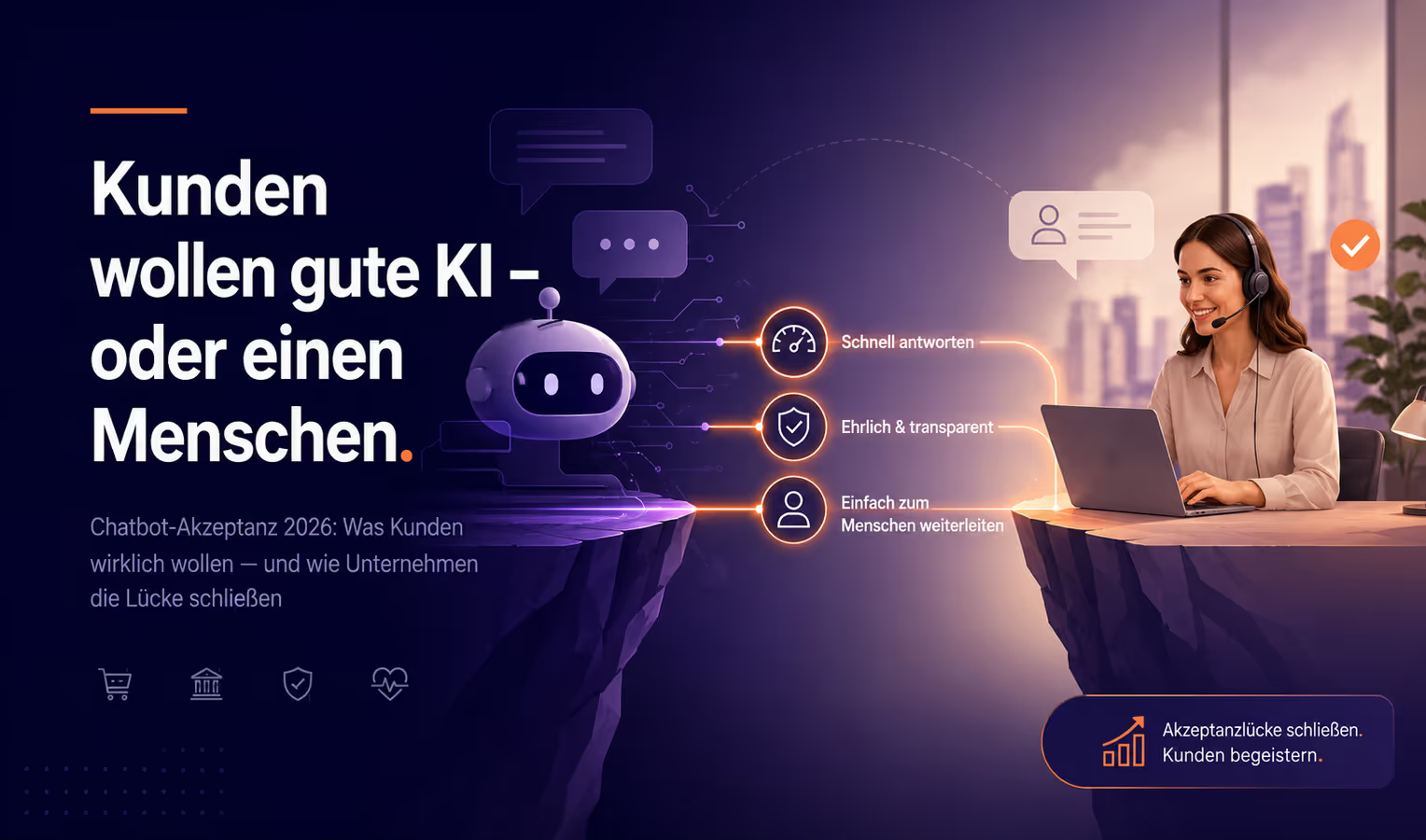
- Three factors decide: response speed, clear escalation to a human and honest transparency about the use of AI.
- Industry differences: e-commerce customers are much more tolerant of chatbots than B2B customers or patients in healthcare.
Definition · Chatbot acceptance
Chatbot acceptance describes customers' willingness to rate an automated, AI-powered conversation as an equivalent or sufficient alternative to human service contact. It's measured as the share of users who say after a chatbot interaction that their issue was resolved satisfactorily — without wanting to escalate.
Companies are gearing up — customers are hesitating. In 2026, this gap shapes everyday customer service like hardly any other topic. On one side: 86% of companies have already implemented or piloted generative AI. On the other: 64% of customers would prefer their providers to do without AI in support altogether. Ignoring this contradiction doesn't just risk poor CSAT scores – it loses customers. 53% of respondents say they would buy from a competitor if they found out their provider uses AI for customer service. This article shows what acceptance really depends on — and what concretely helps close the gap.
The acceptance gap: numbers decision-makers should know
The contradiction between company expectations and customer wishes is measurable and documented.
On the company side: in 2026, 91% of customer service leaders report pressure from executive management to introduce AI (Gartner). 82% of senior leaders say their teams invested in AI for customer service over the past year. 86% of companies have already implemented or piloted generative AI — but only 10% report a mature implementation with measurable impact.
On the customer side: 64% of respondents would prefer companies not to use AI in customer service (Gartner, Dec. 2023, n=5,728). 60% worry that AI will make it harder to reach a human agent. 54% of customers trust human agents more than AI when it comes to product or service recommendations (Gartner, Jan./Feb. 2025, n=5,801). 93.4% of US consumers generally prefer human contact over AI for a service request (Kinsta, April 2025).
What this means: customers don't reject technology — they reject bad experiences. Where AI actually helps faster and more precisely, approval rises: 69% of users who solved their problem on their own prefer self-service when it's available (Zoom + Morning Consult, 2025). For simple requests, 82% of customers would rather use a chatbot right away than wait for a person (Salesforce, State of Service 2024). The pattern is clear: acceptance isn't a question of whether, but how.
When customers accept chatbots — and when they don't
Chatbot acceptance isn't binary. It depends on three factors that companies can influence directly.
Factor 1: response speed
Customers accept AI when it's faster than the alternative. The average response time of an AI chatbot is under three seconds. Human agents need an average of 6.8 hours for a first email reply and around 36 seconds of waiting time in live chat (Thunderbit, March 2026). 82% of customers now expect an immediate response to their request. This time advantage is the strongest driver of acceptance — but only if the answer is also correct.
Factor 2: clear escalation to a human
81% of customers expect a chatbot to hand them over to a human agent when needed — but only 38% experience this always or often (Zoom + Morning Consult, 2025). This gap between expectation and reality is one of the main causes of poor chatbot ratings. The solution is technically simple: a recognizable escalation path that's always available. Companies that offer both self-service and assisted options achieve 30% higher customer satisfaction (SalesGroup AI, 2026).
Factor 3: transparency about the use of AI
Customers who unknowingly interact with an AI and find out later react much more negatively than customers who were informed from the start. According to Zendesk CX Trends 2025, 70% of consumers can clearly tell whether a company uses AI well or badly. Since 2025, the EU AI Act has required all AI systems with customer contact to make it clear to users that they're interacting with an AI system (Art. 50, Regulation 2024/1689). What's a regulatory obligation also acts as an acceptance booster: transparency builds trust instead of destroying it.
Design principles for accepted AI in customer service
The research data yields concrete design rules.
Say what you are. Make it clear at first contact that the customer is interacting with an AI system — not hidden in the small print, but in the chat interface itself. Customers who know accept the interaction more often than those who only suspect it.
Solve the problem, not the category. A chatbot that asks for the tracking number when someone asks “Where's my parcel?” and pulls the current status directly from the shop system builds more trust than one that returns a generic FAQ answer. System integration — for example with Shopware 6 or Zendesk — isn't a nice-to-have but a prerequisite for acceptance.
Make the way out visible. A well-placed “Talk to an agent now” button in the chat window lowers the barrier to trying the chatbot at all. Customers use it less when they know they could press it at any time.
Stay on brand. Customers recognize AI mainly by repetition and formulaic wording — as an analysis by Kinsta from April 2025 shows. Well-configured language models with a brand-specific tone are less often perceived as “machine-like”. This is especially true in the DACH region, where customers have high expectations of German-language quality.
Keep your promises. If a chatbot says it will forward a request or deliver an answer within 24 hours, the system has to make sure that happens. Broken promises destroy acceptance more lastingly than a failed first conversation.
Industry differences: where customers are more tolerant — and where they aren't
Chatbot acceptance isn't the same across industries. The following assessment is based on published studies and typical project data.
E-commerce has the highest acceptance: customers are transaction-oriented and value speed and 24/7 availability above all. They want to know where their parcel is, start a return or check a voucher code — rule-based requests that a well-connected chatbot resolves faster than any queue. According to ControlHippo (2025), 37% of online shoppers even actively prefer the chatbot to a human agent for simple requests. The biggest hurdle isn't the AI itself but missing backend integration: a chatbot without real-time access to order data gives generic answers and immediately loses trust.
Gyms and sports clubs sit at a medium level of acceptance. Standard requests about opening hours, class schedules and prices work well. When it comes to membership cancellations or complaints, willingness drops — customers expect human empathy here, and a chatbot without automatic handover logic makes things worse instead of solving them.
In the B2B mid-market, the starting point is harder. Buyers and project managers have complex requests, high security awareness and expect expert contacts. Acceptance here comes almost exclusively in Agent Assist mode: the chatbot prepares context, the human leads the conversation. Fully automated solutions only work for very narrowly defined use cases like password resets, status queries or standard FAQs.
Healthcare and financial services bring up the rear. Additional regulation — medical device law, MiFID II — further limits the scope. Here, chatbots make sense as a triage tool or for administrative requests, never as the only touchpoint.
What to do if your chatbot is rejected
If a company gets negative signals from its chatbot — rising drop-off rates, poor CSAT after bot interactions, lots of escalations — these four diagnoses help.
1. No clear escalation path: check whether the handover to a human agent can be reached in under two clicks. If not, that's the first lever.
2. Missing system integration: a chatbot without a connection to the ticket system (Zendesk, Freshdesk, GREYHOUND) or the shop system (Shopware, Shopify) can't give context-specific answers. It then gives generic answers — and loses trust.
3. The wrong use case: chatbots used for complex, emotional or security-relevant requests without handover logic reliably fail. The scope must be clearly defined and communicated.
4. No feedback loop: without systematic monitoring — drop-off rates, CSAT per bot session, escalation rate — there's no data-driven optimization. Providers like melibo provide these metrics in a dedicated analytics dashboard, letting teams pinpoint weak spots in the conversation flow.
Read more: The future of e-commerce customer service: AI agents · How to use chatbots in your company in a GDPR-compliant way
Free strategy session
Now you know what drives chatbot acceptance.
Let's check how your customers will respond.
In a free 30-minute call, we'll look at your request types, escalation paths and integrations and show you how to build an AI agent your customers actually like to use — no sales pressure.
Book a free call →Frequently asked questions (FAQ)
Do customers accept chatbots in customer service in 2026?
It depends: customers accept chatbots for fast, clearly defined requests — especially in e-commerce. For complex, emotional or security-relevant requests, 54% of customers still prefer human agents. Acceptance rises measurably when the chatbot is clearly recognizable as AI, gives correct answers and can hand over to a human at any time.
What are the most common reasons customers reject chatbots?
According to Gartner (2024), the three biggest concerns are: (1) fear of no longer reaching a human contact (60%), (2) worry about wrong answers (42%), (3) data protection concerns (34%). On top of that, there's a structural problem: many chatbots don't recognize the limits of their own competence and don't escalate in time — leading to frustration instead of solutions.
Which industries have the highest chatbot acceptance?
E-commerce clearly leads: customers here are transaction-oriented and value response speed above all. Travel and telecommunications follow. Healthcare and financial services show the lowest acceptance, as trust and regulatory requirements play a bigger role than speed.
Do I have to disclose that my chatbot is an AI?
Yes. Since the EU AI Act began coming into force in stages from 2024, companies in the EU are required to inform users that they're interacting with an AI system. Beyond the legal obligation, transparency drives acceptance: customers who know from the start are much more tolerant of mistakes and more frequent escalations.
How do I measure whether my chatbot is accepted?
The four most important metrics are: drop-off rate in bot conversations, CSAT score after bot interactions, escalation rate (share of bot sessions handed over to a human) and containment rate (share of requests resolved fully automatically).
The goal isn't the lowest possible escalation rate — but high customer satisfaction, regardless of whether a human or the AI resolves the request.