
AI agents for enterprises: what large companies need to consider with AI in customer service in 2026
TL;DR: the essentials in 30 seconds
- The difference isn't the AI: an enterprise-ready AI agent differs from a mid-market tool in security, governance and integration depth.
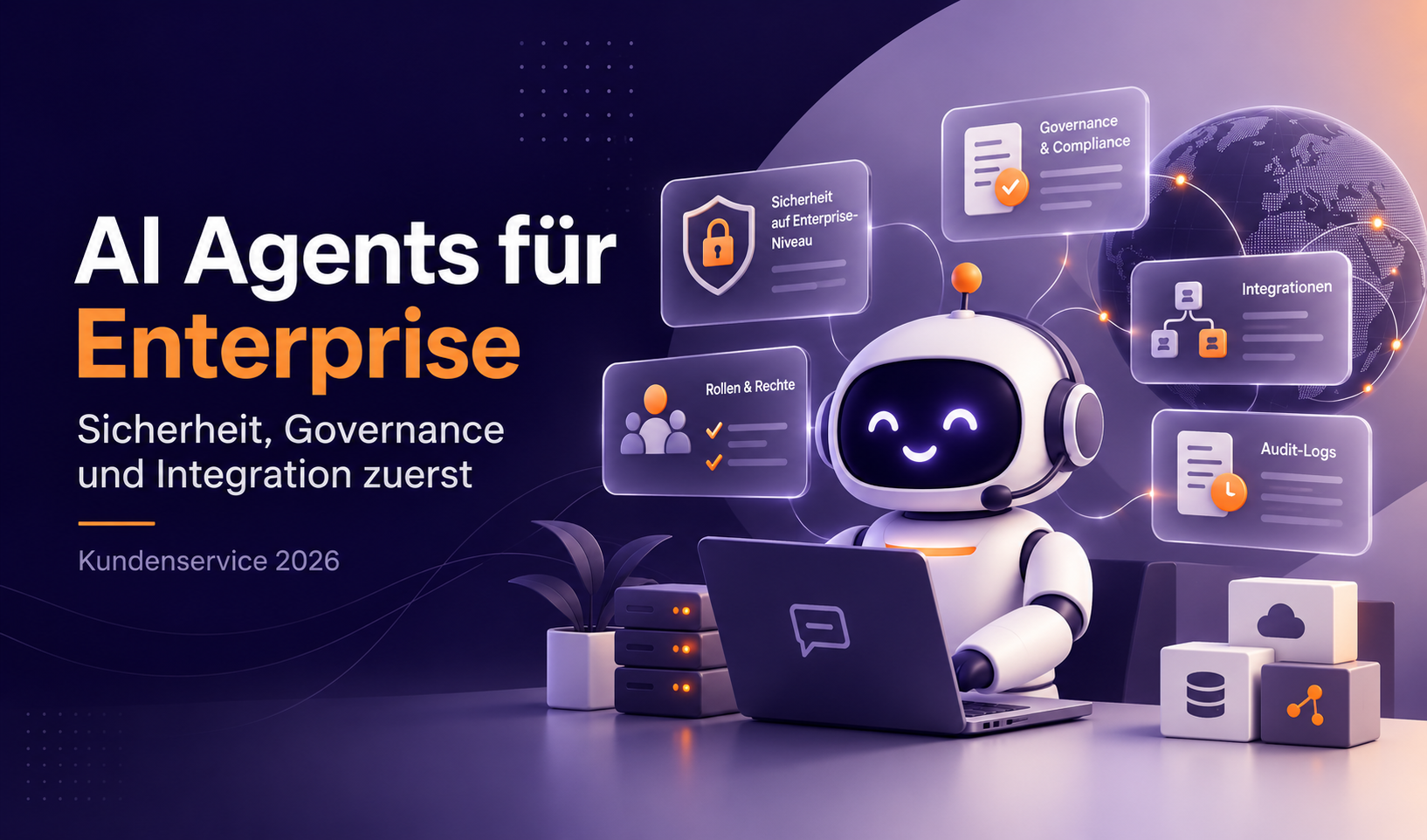
- Must-have requirements: audited certifications such as ISO 27001 or a BSI C5 attestation, single sign-on, a fine-grained role and permission system, audit logs and multi-tenancy for brands and countries.
- Involve the works council from the start: if the system evaluates data about employees, co-determination rights under Section 87(1) No. 6 of the German Works Constitution Act (BetrVG) apply.
- Vendor dependency: since Salesforce's acquisition of Fin in September 2026, enterprises should contractually agree exit scenarios and data export.
An AI agent is enterprise-ready when it doesn't just resolve requests but fits into a company's security architecture, permission model and approval processes. Most providers' language models are now comparably good. What makes the difference is certifications, identity management, auditability, integrations with SAP, Salesforce or Microsoft Dynamics and the ability to manage multiple brands, countries and languages centrally. This article shows which requirements you should set and how to roll out successfully in a large organization.
Definition:
An enterprise-ready AI agent is an AI system for customer service that, in addition to resolving requests on its own, meets the requirements of large organizations: audited information security, connection to central identity management, granular permissions, complete logging, multi-tenancy and contractually guaranteed availability.
How do enterprise requirements differ from those of mid-sized companies?
In mid-sized companies, a small team usually decides on a tool quickly. In large enterprises, IT security, data protection, procurement, the works council and often several country subsidiaries all review it. So an AI agent doesn't just have to work – it has to pass every one of these reviews.
Three differences shape almost every enterprise project. First, the complexity of the system landscape: instead of one shop system and one helpdesk, there's ERP, CRM, several ticket systems and custom portals. Second, the number of people involved: content is maintained by different departments, each allowed to edit only its own topics. Third, the burden of proof: every decision the system makes must be traceable if needed, for internal audit, data protection or the customer.
Which security and compliance certifications should you ask for?
Ask for audited certifications, not self-declarations, before any contract negotiation. For cloud services in Germany, ISO 27001 and the BSI's C5 criteria catalog are the most important references.
The BSI C5 criteria catalog defines minimum information security requirements for cloud services. Compliance is attested by auditors, and the BSI recommends that customers request the audit report at the start and annually thereafter and evaluate it themselves. The catalog was fundamentally revised in 2025 and 2026. So ask which version an attestation refers to and whether it also covers the infrastructure the AI agent runs on.
The following points also belong in every review: a data processing agreement under Art. 28 GDPR with a complete list of subprocessors, data processing in the EU including the language models, a written commitment that customer data won't be used to train third-party models, regular penetration tests and a documented process for security incidents with fixed reporting deadlines.
Why are roles, permissions and multi-tenancy so important?
In a large enterprise, many teams maintain the same AI agent. Without granular permissions, the legal department accidentally overwrites product texts, or one country subsidiary changes content belonging to another brand.
An enterprise-ready agent therefore needs four building blocks. Single sign-on via SAML or OpenID Connect connects the system to central identity management, such as Microsoft Entra ID, so access is removed automatically when employees leave. Role-based permissions define who can read, edit or approve which content. Multi-tenancy cleanly separates brands, countries or business units, with a shared knowledge base for overarching topics if needed. Approval workflows ensure that sensitive content such as warranty terms or prices only goes live after a four-eyes review.
How relevant this is in practice is shown by user reviews on OMR Reviews: providers like melibo have built role and permission systems so that different departments can maintain content without changing or deleting content belonging to other organizational units. Ask every provider for a live demo of exactly this scenario.
Which integrations does an AI agent need in a large enterprise?
An AI agent in a large enterprise must be able to read from and write to the existing core systems; otherwise it remains an FAQ bot with an enterprise price tag. Native integrations for the systems where customer data and processes live are crucial.
Typical examples are CRM systems such as Salesforce Service Cloud or Microsoft Dynamics 365, ERP systems such as SAP S/4HANA, helpdesks such as Zendesk or ServiceNow, and custom customer portals. Where no native integration exists, you need open REST APIs, webhooks and the ability to connect your own actions securely. Also check whether the agent uses defined permissions per action rather than a master key to all systems.
For an overview of which providers actually resolve how many requests on their own, see our comparison of AI agent tools for DACH customer service.
Six review areas for enterprise AI agents
The questions IT security, data protection and procurement ask in large enterprises
Security and certifications
ISO 27001 or BSI C5 attestation in place?
Which version, what audit scope?
Regular penetration tests?
Data protection
DPA under Art. 28 GDPR with subprocessor list?
Processing in the EU, including the language model?
No training on customer data?
Identity and permissions
Single sign-on via SAML or OpenID Connect?
Roles per department and content type?
Four-eyes approvals?
Integration
Native connection to CRM, ERP and helpdesk?
Open APIs and webhooks?
Permissions per action instead of a master key?
Governance and audit
Complete logs of all answers and actions?
Tenants for brands and countries?
Rules for model changes?
Operations and contract
Guaranteed availability with service credits?
Response times by severity?
Data export and exit terms?
When do you need to involve the works council?
As soon as an AI agent collects or evaluates data that allows conclusions about employees' behavior or performance, the works council has co-determination rights. That applies to almost every enterprise project.
Under Section 87(1) No. 6 BetrVG, the works council has a say in the introduction and use of technical devices designed to monitor employees' behavior or performance. Case law interprets this broadly: it's enough for a system to be objectively capable of doing so. An AI agent that logs handovers to individual employees, measures handling times or evaluates reply suggestions with Agent Assist features generally falls under this.
So plan talks with the works council before the pilot, not after. A works agreement typically governs which data is collected, who may see evaluations, that individuals' performance isn't monitored and how long logs are kept. In parallel, data protection checks whether a data protection impact assessment under Art. 35 GDPR is needed.
Then there's the EU AI Act: customer service chatbots generally fall under limited risk and must be recognizable as AI under Art. 50. We describe the specific obligations in our article on the EU AI Act in customer service.
How do you roll out an AI agent across countries and brands?
Start with one brand, one country and a few request types, and only then build out the structure for further units. Launching in all countries at once almost always fails due to coordination effort.
A four-phase approach has proven effective. In the pilot, the agent resolves three to five high-volume request types for one unit and delivers robust metrics. In the approval phase, the results are presented to IT security, data protection and the works council, and the works agreement is finalized. In the rollout, further countries and brands are added, each with its own language review and local content. In regular operation, a central team takes over governance: it defines standards, monitors metrics and approves new use cases.
On multilingual support: modern language models handle many languages well, but legal terms, product names and tone must be checked for each market. A central knowledge base with country-specific variants is usually better than separate systems per country.
From pilot to regular operation in a large enterprise
Four phases that have proven themselves in enterprise projects
Pilot
One brand, one country
Automate three to five high-volume request types and collect robust metrics.
Approval
IT security, data protection, works council
Present results, conclude the works agreement, check the data protection impact assessment.
Rollout
More countries and brands
Add local content, check language quality per market, set up tenants.
Regular operation
Central governance team
Set standards, monitor metrics, approve new use cases.
CRM vendor platform, specialist provider or in-house build?
Large enterprises have three options, and each comes at its own price. What matters is how much you value independence, integration breadth and speed.
AI from your CRM or helpdesk vendor: Salesforce Agentforce – which, since the Fin acquisition closed in September 2026, has been extended with the former Intercom platform – Zendesk AI or Microsoft Copilot for Service are tightly integrated into their own platforms. The advantage is seamless connectivity; the disadvantage is greater vendor dependency and often limited options outside the vendor's own ecosystem.
Specialist platforms: providers like Cognigy, which mainly targets large contact centers, and moinAI and melibo in the German-speaking region work across systems and can be combined with different CRM, ERP and helpdesk systems. Check certifications and scalability particularly carefully here.
In-house build: a prototype based on Azure OpenAI, Mistral or other models is quick to build. The real costs come with operation, maintenance and compliance. When it pays off is shown in our make-or-buy check for AI chatbots.
Whichever route you take, large enterprises should contractually agree how the knowledge base, conversation data and configuration can be exported if they switch providers. Market consolidation makes this point more important than ever in 2026.
Which SLAs and operational topics belong in the contract?
An AI agent in customer service is a critical system – if it fails, every request lands with the team. The contractual commitments need to reflect this.
Negotiate guaranteed availability with clear service credits if it's not met, defined response times for incidents by severity and a dedicated contact person. Also clarify how the provider handles model changes: if a language model is replaced, the answer behavior can change. So ask for advance notice, a test phase and the option to check critical use cases before the switch. Finally, add terms on data deletion after the contract ends and on data export.
Frequently asked questions about AI agents in an enterprise setting
Do large enterprises need a different AI agent than mid-sized companies?
Not necessarily a different AI, but a different platform around it. Single sign-on, granular permissions, multi-tenancy, audit logs and audited security certifications are mandatory in large enterprises and often optional in mid-sized companies.
Is a BSI C5 attestation mandatory for AI agents?
It isn't legally required for most companies. But many large enterprises, public authorities and regulated industries require it in their procurement guidelines. At the very least, ISO 27001 certification should be in place.
Does the works council have to approve the introduction of an AI agent?
If the system evaluates data that allows conclusions about employees' behavior or performance, the works council has co-determination rights under Section 87(1) No. 6 BetrVG. In practice, this is governed by a works agreement.
How long does an enterprise rollout take?
That depends less on the technology than on the approval processes. A pilot for one unit can often be implemented in a few weeks. A rollout across several countries and brands usually takes considerably longer, because committees, language review and local content come on top.
Should you use your own CRM vendor's AI?
That can make sense if almost all processes run in the CRM. With heterogeneous system landscapes, specialized cross-system platforms are often more flexible. In both cases, data export and exit scenarios should be agreed contractually.
Conclusion: governance decides success
For large enterprises in 2026, the question isn't whether an AI agent can resolve customer requests, but whether it fits securely and controllably into the organization. Audited security certifications, single sign-on, granular permissions, multi-tenancy and deep integrations are the ticket to entry. The process is just as important: if you involve the works council and data protection early, start with a clearly limited pilot and secure exit scenarios contractually, you'll reach regular operation faster. Market consolidation shows how quickly provider landscapes can change. An architecture that stays independent is therefore a strategic decision.
Enterprise consultation
Is your company planning AI agents in customer service?
Let's talk about architecture and rollout.
In a call with our team, we'll clarify how an AI agent fits into your system landscape, which certifications your IT security needs and what a pilot can look like that brings data protection and the works council on board from the start.
Book a call →