AI chatbot vs. live chat: which is better for which use case in 2026?
TL;DR — the essentials in 30 seconds
- An AI chatbot answers requests automatically and around the clock; live chat connects customers with a human agent in real time.
- For standard requests such as order status, returns or opening hours, an AI chatbot is the faster and cheaper solution.
- For emotional, high-value or highly individual issues, live chat with real people keeps the edge.
- Most DACH companies in 2026 rely on a hybrid model: the chatbot handles pre-qualification, complex cases go to a human.
- From August 2, 2026, the transparency obligation under Art. 50 of the EU AI Act applies to both channels as soon as an AI system is used in the chat.
Definition:
An AI chatbot is a software system that recognizes customer requests via text and answers them automatically, without a human stepping in. Live chat, by contrast, is a chat channel in which a human agent communicates with the customer in real time. The two approaches can be combined, with the chatbot handling standard cases and handing complex issues over to a human.
In 2026, many customer service leaders face the same decision: is an AI chatbot enough, or do you still need live chat with real people? The answer doesn't depend on the technology but on the use case. This article shows where the two channels differ, what they cost and how to combine them sensibly.
What's the difference between an AI chatbot and live chat?
An AI chatbot processes customer requests using natural language processing and a knowledge base and answers without human involvement. Live chat, on the other hand, is essentially just the communication channel through which a person types in real time. The chatbot replaces staff effort; live chat merely adds a digital channel to it.
The practical difference shows mainly in scaling. An AI chatbot answers 500 or 5,000 simultaneous requests at the same speed. Live chat is tied to your team's capacity: more simultaneous chats mean longer waits or more staff.
Response time and availability: who answers faster?
An AI chatbot usually answers in under two seconds and is available 24/7, including weekends and public holidays. Live chat with human agents is tied to business hours and, under heavy load, reaches waiting times from several minutes to hours.
For customers with a simple question outside business hours, such as order status, a chatbot clearly has the edge. But as soon as a real conversation with several follow-up questions is needed, this advantage shrinks: a chatbot without a clean knowledge base tends to cause frustration rather than save time on complex issues.
To measure the success of both channels, look at first response time, i.e. the time between the request and the first reply. A chatbot brings this value down to practically zero, while live chat ties it directly to team size.
What does an AI chatbot cost compared to live chat?
For mid-sized DACH companies, an AI chatbot costs between €50 a month for simple FAQ bots and €2,500 for full AI agent solutions with system integration, depending on ticket volume and integration depth. On top come one-off setup costs ranging from a few hundred to several thousand euros, depending on whether native connectors to systems like Shopware or Zendesk are available.
Live chat with human agents, on the other hand, causes ongoing staff costs. At an hourly rate of €45 and an average handling time of 6 minutes per ticket in DACH customer service, each chat costs around €4.50. At 1,000 chats a month, that's €4,500 in handling time alone, without training, tools or overhead. A chatbot that takes over a relevant share of these standard requests automatically reduces these costs noticeably, because handling time per automated ticket drops practically to zero.
Important for the calculation: a chatbot rarely replaces the entire live chat team. What's realistic is a reduction in the ticket volume people have to handle, not a complete replacement.
For which use cases is an AI chatbot the better choice?
An AI chatbot is particularly suited to requests that recur frequently and are clearly structured. Order status queries can be answered in real time via a native connection to systems like Shopware 6 or Shopify, without an agent having to look in the ERP system. Return requests usually follow a fixed process and can be automated just like opening hours, prices or shipping costs.
A chatbot also plays to its strengths with high ticket volumes and seasonal peaks. An online shop with a Q4 peak doesn't have to scale up its live chat team at short notice if a chatbot absorbs the base load. The same goes for multilingual first contact: a chatbot answers requests in German, English or French without multilingual staff having to be available around the clock.
When does live chat with real people stay ahead?
With emotionally charged issues, such as complaints or claims with high frustration potential, customers expect empathy that a chatbot can't convincingly simulate. A failed attempt by the bot tends to increase annoyance rather than resolve it.
In B2B sales and high-value advisory situations, human contact also remains crucial. When a customer makes a five-figure investment decision, they expect a contact who responds individually to their situation, not an automated answer from the knowledge base. The same goes for complex one-off cases without a clear template, such as special contract terms or technical problems outside the documented standard cases. Here, a chatbot often leads to loops, while an experienced agent can put the situation into context in a few sentences.
How do you combine both channels sensibly?
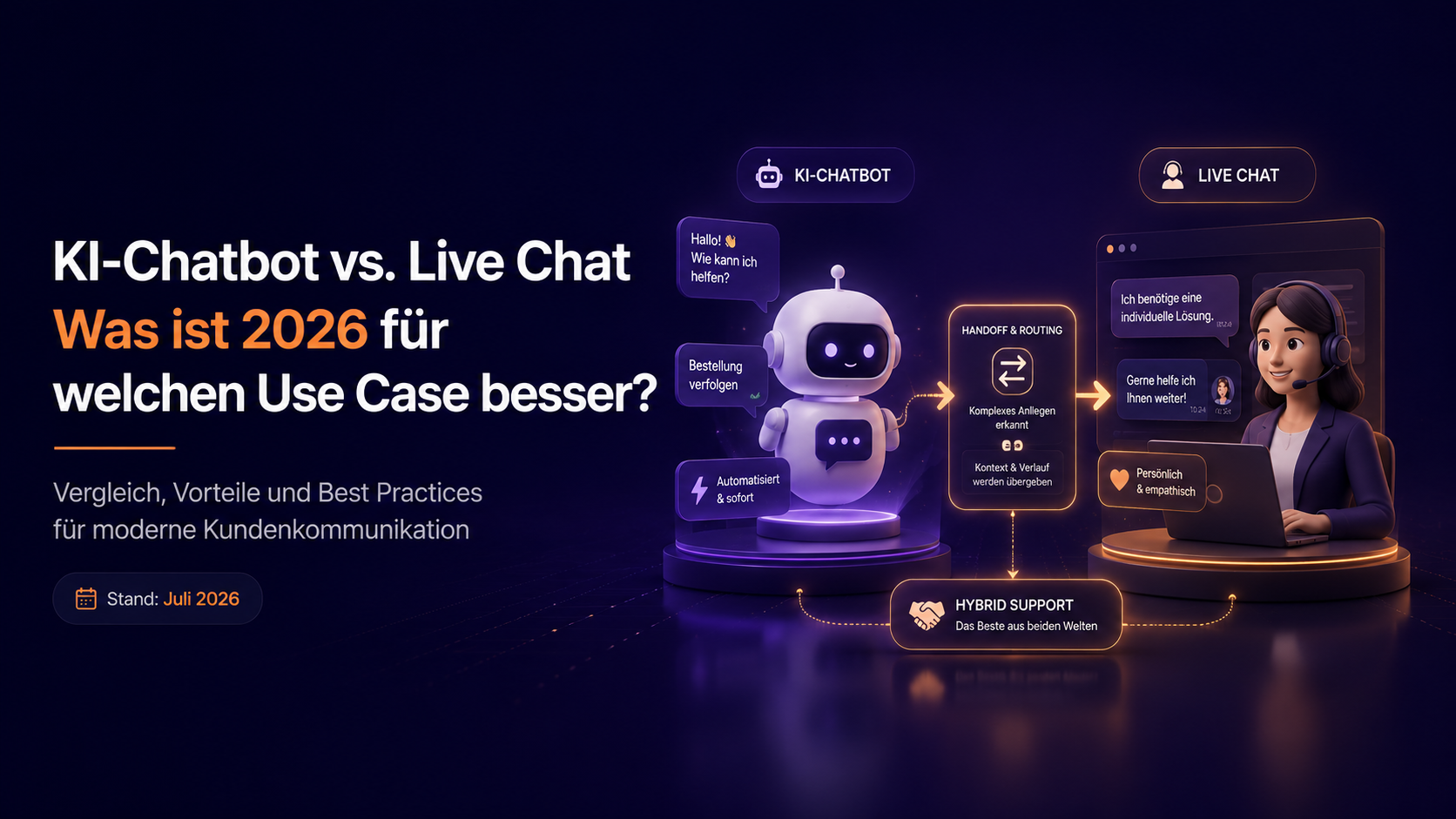
Most successful setups in the DACH mid-market in 2026 work in a hybrid way: the chatbot handles first contact, answers standard requests fully automatically and recognizes when an issue is too complex for it. In that case, it hands over cleanly to a human live chat agent, including the conversation so far, so the customer doesn't have to repeat themselves.
In practice, this handover works in two modes. With a full handover, the human takes over the conversation completely. With Agent Assist, the chatbot stays active in the background and supports the human agent with reply suggestions and summaries, while the agent sends the final answer. This ability to decide independently when a handover is needed is rooted in the concept of agentic AI, where a system doesn't just react but assesses situations on its own and initiates the right next steps. Providers like melibo build this handover logic directly into helpdesk systems such as Zendesk or Freshdesk, so the service agent sees the full context without switching tools. The melibo article What are chatbots and how do they work? explains more about how these hybrid systems work.
(e.g. order status, return, opening hours)
How do customers accept AI chatbots compared to live chat?
A survey by Bitkom Research shows that most online shoppers want a human contact when they have problems: 62 percent would prefer to turn to a quickly reachable human contact if something goes wrong, while only 36 percent prefer a chatbot. At the same time, automated customer service already convinces half of the users who have actually used it, as the Bitkom survey “Customer service in online shopping” shows.
In practice, this means: a chatbot doesn't have to solve every case to be accepted, but it should be able to visibly escalate to a person if the customer wants. A comparison of different customer service software shows that customers are much more tolerant of a chatbot when a smooth handover to a live chat agent is guaranteed.
The GDPR, the EU AI Act and the transparency obligation for both channels
As soon as a chat system processes personal data, the GDPR applies, regardless of whether a person or an AI responds. Under Art. 5 GDPR, data must be processed lawfully, for a specific purpose and limited to what's necessary. For live chat, this mainly concerns storing chat histories; for AI chatbots, it also raises the question of whether customer data is used to train third-party models.
For AI chatbots specifically, the transparency obligation under Art. 50 EU AI Act, Regulation 2024/1689 also applies from August 2, 2026: users must be able to recognize that they're talking to an AI system and not a person, unless this is obvious anyway. For live chat with real agents, this obligation naturally doesn't apply. Providers like melibo, which host in Germany and deliver chatbots with a transparency notice by default, largely take this compliance step off companies' hands. How companies set up their chatbots in a privacy-compliant way is described in detail in How to use chatbots in your company in a GDPR-compliant way.
Free strategy session
Find out whether chatbot, live chat or hybrid is the right solution for you
In a free call, we'll analyze your ticket volume and show you how an AI agent automates standard requests while your team focuses on complex cases.
Frequently asked questions (FAQ)
Can an AI chatbot completely replace a live chat agent?
No. In practice, a chatbot takes over part of the ticket volume, typically the recurring standard requests. Complex, emotional or high-value issues stay with people. What's realistic is a reduction in the volume your team has to handle, not a complete replacement.
How quickly does an AI chatbot pay off compared to live chat?
That depends on ticket volume. At an hourly rate of €45 and 6 minutes of handling time per ticket, a manually handled chat costs around €4.50. If a chatbot fully automates just 500 tickets a month, that's over €2,000 in savings, often much more than the monthly license fee.
Can an AI chatbot be used in a GDPR-compliant way in the German market?
Yes, provided the provider offers a data processing agreement under Art. 5 and 28 GDPR and doesn't use customer data to train third-party models. A hosting location in Germany or the EU makes proving compliance even easier.
Does an AI chatbot have to be recognizable as such?
Yes. From August 2, 2026, Art. 50 EU AI Act requires that users can recognize when they're talking to an AI system instead of a person, unless this is obvious. A corresponding notice in the chat window is the usual way to implement this.
How does the handover from chatbot to human live chat agent work?
Based on complexity, sentiment or an explicit user request, the chatbot recognizes when it can't resolve a conversation and hands it over, including the conversation history, to a live chat agent. That way, the customer doesn't have to repeat themselves. This logic can be integrated directly into helpdesk systems like Zendesk or Freshdesk.
Conclusion
In 2026, choosing between an AI chatbot and live chat is no longer an either-or but a question of dividing up tasks. Standardized, recurring requests belong in automation, because they're handled faster, cheaper and around the clock there. Emotional, high-value or highly individual issues stay with people, because trust and empathy make the difference there. If you combine both channels with clean handover logic, you cut costs without sacrificing service quality at the critical points.