
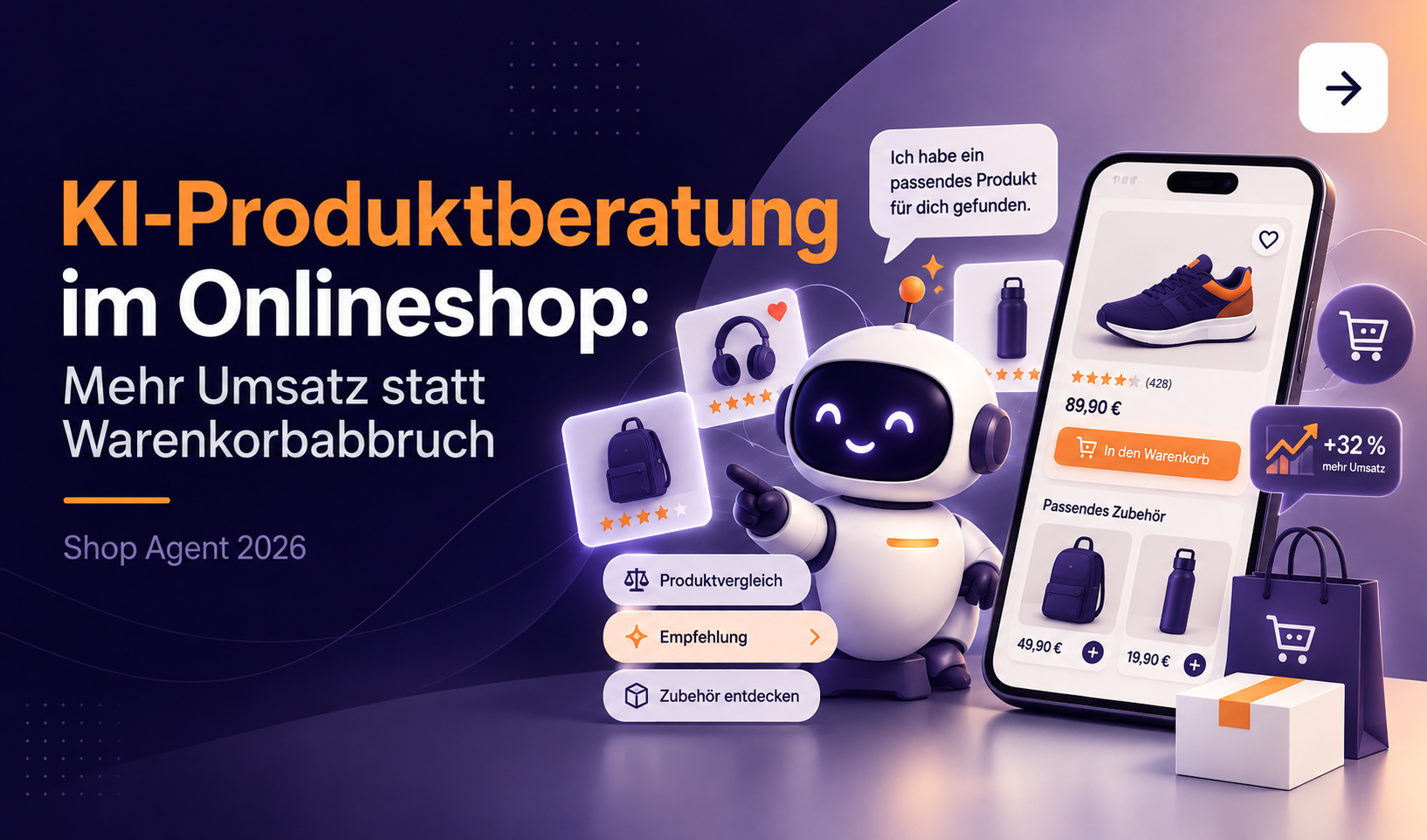

AI product advice in online shops in 2026: how a shop agent turns doubts into purchases
TL;DR: the essentials in 30 seconds
- What it is: a shop agent is an AI agent that advises customers in the online shop before they buy: with product recommendations, answers to detailed questions, product comparisons and cross-selling in real time.
- Why it matters: around 70% of all shopping carts are abandoned, often because of open questions just before purchase. A shop agent answers exactly these questions, around the clock.
- Business case: a support chatbot mainly cuts costs. A shop agent also improves conversion rate, basket value and return rate.
- Features in 2026: advice controlled by guidelines, product comparisons in the chat, questions on the product detail page and KPI tracking of click rate and revenue are standard today.
- Prerequisite: the quality of the advice depends on the product feed. It's connected via CSV, feed URL or directly from Shopware and Shopify.
- Build or buy: in September 2026, Anthropic published Claude Commerce Agents, an open blueprint for developer teams. Ready-made shop agents, on the other hand, go live in a few weeks without an IT project of your own.
- Legal: the GDPR and the transparency obligation under Art. 50 EU AI Act apply to shop agents just as they do to any chatbot.
Definition:
A shop agent is an AI agent in the online shop that actively advises customers before they buy. It understands needs expressed in natural language, asks follow-up questions, recommends suitable products from your own catalog and compares alternatives. Unlike a support chatbot, which resolves service requests, a shop agent leads to a purchase decision.
AI product advice in the online shop means an AI agent takes on the role of a salesperson: it clears up questions about material, fit or compatibility immediately in the chat and suggests suitable products. That's exactly where most purchases fail – with doubts just before buying. This article shows how a shop agent works, which features matter in 2026, what results are realistic and when building your own pays off rather than buying a ready-made product.
What is a shop agent, and how does it differ from a support chatbot?
A shop agent advises before the purchase; a support chatbot resolves service requests after it. Both often run in the same chat widget but pursue different goals. The support agent answers questions about order status, returns or delivery times and avoids tickets. The shop agent understands the need behind a request like “I'm looking for a bed made of sustainable wood” and derives concrete product recommendations from it.
Technically, it's based on two building blocks. Natural language processing (NLP) recognizes the intent and context of the request. Retrieval-augmented generation (RAG) ensures the agent only uses information from your own product catalog, not general training knowledge. This significantly reduces the risk of made-up product details, which has a direct effect on the return rate when it comes to material details or size charts.
Why do customers abandon purchases in online shops?
Customers abandon because they can't clear up open questions themselves. According to the Baymard Institute, the average cart abandonment rate is around 70%, a figure that has barely changed for years. Classic shop filters know categories, not needs: no dropdown menu understands “I need something for sensitive skin”.
The gap is structural. There are too many options and no one to ask, no advice outside opening hours, and speculative purchases that later come back as returns. At the same time, search behavior is changing. The buying process used to run through searching, filtering, comparing and buying. Today, customers describe their needs in a dialog, and the AI takes over filtering, comparing and recommending. According to Adobe Analytics, traffic from generative AI sources to US retail websites in February 2025 was 1,200% higher than in July 2024. If you're used to getting advice in a dialog, you expect it in the shop too.
Is a shop agent worth it for online shops?
A shop agent is worth it especially for shops with an advice-intensive range, because it doesn't just cut costs – it generates revenue. A support chatbot automates recurring questions and takes the load off the service team. The Deuba success story shows this cost effect: the online retailer saves over €5,000 a month through customer service automation. But a support chatbot only affects revenue and order value indirectly.
A shop agent comes in one step earlier. It guides undecided customers to the right product, resolves doubts before purchase and suggests suitable accessories, with no extra staff costs per conversation. So in addition to tickets saved, conversion rate, basket value and avoided returns also feed into the business case. Use the following calculator to estimate the effect for your own shop.
Revenue lever calculator: what does product advice in the chat deliver?
Enter your shop's figures. The calculator shows how much additional revenue you generate when advised visitors buy more often.Default values are example assumptions, not benchmarks. For orientation: at checkyeti, the conversion rate directly in the chat was 4%. Effects on basket value and returns aren't included.
There's also a strategic reason. As customers increasingly get their purchase advice in ChatGPT, Perplexity or Google AI Overviews, retailers lose control over brand voice, advisory logic and customer data. Your own agent in your own shop keeps these factors in-house: you decide how advice is given, which products take priority and where the conversation data is stored.
Which features does a shop agent need in 2026?
In 2026, a shop agent needs four functional areas: advice in the chat, questions and comparisons, product data integration, and training and analytics. The melibo shop agent shows how these areas work together.
How a shop agent works: four functional areas to click through
Choose an area to play the conversation in the sample shop.Product advice in the chat: controlled by guidelines
The product advisor runs as a chat widget in the shop and starts via topic triggers, such as a button like “Help me find the right tent”. Guidelines are advisory rules that define which follow-up questions the agent asks and by which criteria it selects products. An outdoor shop can specify, for example, that the agent always asks about the number of people and the time of use for tents. The matching products then appear as a preview with image, price and link directly in the chat.
Questions and comparisons: in the chat and on the product detail page
Customers ask questions about every suggested product and compare several suggestions in a targeted way, for example “Which of the two tents is lighter?”. Advice is also possible on the product detail page: a dedicated frontend widget starts the conversation about the specific product there. That's exactly where the last doubts before purchase arise.
Connecting product data: with an AI assistant for attribute matching
Product data can be connected in four ways: as a CSV file, as a product feed via URL, or directly from Shopware and Shopify. During setup, an AI assistant suggests adjustments for matching product attributes. If a field in the feed is called “ws_mm” instead of “hydrostatic head”, for example, the assistant recognizes this and suggests the mapping.
Improving and analyzing: Bot Gym, training and KPIs
In the Bot Gym, melibo's training area, you analyze conversations and retrain guidelines in a targeted way. This shows you where the agent suggested an unsuitable product or skipped an important follow-up question. Performance KPIs show the click rate (CTR) on suggested products and the revenue the shop agent generates. That makes product advice measurable.
What product data does a shop agent need?
A shop agent needs a complete, structured product feed, because it can only advise as well as it knows the range. The more attributes are maintained – material, dimensions, variants, target group, compatibility, care instructions and availability – the more accurate the recommendations.
Structure is what matters. Attributes belong in separate fields, not in the running text of the product description. “Washable at 30 degrees” in the “care instructions” field can be evaluated reliably by the agent; the same information in the middle of marketing copy can't. An incomplete or outdated feed leads to vague answers. So before a shop agent goes live, it's worth checking for complete variants, up-to-date availability and consistent categorization. Use the following self-check to see how well your feed is already set up.
Is your product feed ready for a shop agent?
Tick off what's already reliably maintained in your feed.Select the points your feed already meets.
What results do shop agents achieve in practice?
Shop agents achieve measurable conversion effects when the product range is advice-intensive. The travel portal checkyeti connects customers with ski schools, guides and activity providers across Europe. With every request, activity type, location, availability, minimum age and cancellation terms have to match. With the shop agent, checkyeti achieves an automation rate of around 55% and a touch rate of 71% across all requests. Directly in the chat, 2,471 interactions led to 173 bookings from 88 customers – a conversion rate of 4%. Via the complementary ticket automation channel in the Zendesk helpdesk, a further 402 bookings from 211 customers came from 465,787 website visitors and 2,031 leads – a conversion rate of 21%. All details are in the checkyeti case study.
A shop agent is also running productively at Bogensportwelt, Germany's largest shop for archery and crossbows. It answers questions about draw weight, compatibility or suitability for beginners. Asked “I'm looking for a recurve bow with 50 lbs draw weight”, it suggests suitable models, explains the differences between compact, traditional and take-down designs and narrows the selection down to right- or left-handed on request. There's no public success story on this yet, but the example shows that the concept also works for products that need a lot of explanation. How high the conversion rate turns out in each case depends on the buying cycle and product complexity.
What's the difference between a shop agent and a recommendation engine?
A shop agent holds a dialog; a recommendation engine analyzes behavior. Recommendation engines show notes like “Customers also bought” or sort by previous click behavior. That works for broad trends but doesn't answer a specific question like “Does this bed fit a 160 cm wide slatted frame?”. A shop agent understands such questions, asks follow-ups and compares products directly with each other. When choosing, the RAG connection to your own catalog is important: systems that tie answers and prices to the catalog data don't invent product features.
Claude Commerce Agents or a ready-made shop agent: what suits your shop?
Claude Commerce Agents suits companies with their own developer team; a ready-made shop agent suits shops that want to start quickly without an IT project. On September 2, 2026, Anthropic published a blueprint for commerce agents. It contains reference implementations for a shopping agent for customers and a merchant agent for shop staff, plus a plugin for Claude Code that guides developer teams through the integration.
The blueprint's shopping agent searches the catalog, puts together sets of several items, remembers preferences and shows products and the cart right in the conversation. It hands the cart over to checkout; payment processing stays with the merchant. It also answers service questions such as order status or returns. According to Anthropic, retailers using shopping agents based on Claude achieve up to 35% larger baskets and a 60% higher likelihood of completing a purchase. The template runs via the Claude API, Amazon Bedrock, Microsoft Foundry or Google Cloud Vertex AI.
However, the blueprint isn't a finished product. Every connection to catalog, cart and shop system is a development project, and hosting, maintenance and monitoring lie with your own team. There's no interface for training, conversation analysis or KPI reporting. Costs are usage-based via API tokens, and Anthropic doesn't publish a cost estimate per conversation. Where data is processed depends on the cloud platform and region; your own team is responsible for a GDPR-compliant setup.
A ready-made shop agent like melibo's goes live in around 30 business days without a developer team of your own. It's controlled via an editor with guidelines, Bot Gym and a KPI view, hosted in Frankfurt am Main and billed via a fixed-price or usage subscription with fixed terms. There are clear limits too, though. The melibo shop agent currently doesn't offer cart and checkout in the chat; it hands over to the shop's existing checkout. That saves a separate payment project with payment methods and PCI compliance. Customers put together sets step by step, and order status questions are handled by the support agent. Non-physical products such as tariffs, events or tickets require a custom implementation.
The decision comes down to two questions. Can your own team build, host and permanently maintain an agent? Then the blueprint offers maximum design freedom, including checkout in the chat. Do fast go-live, control by the business team, predictable costs and hosting in Germany matter most? Then a ready-made shop agent is the better fit. The following check helps you decide.
Build your own with a blueprint or use a ready-made shop agent?
Tick all the statements that apply to your shop.Select the statements that apply to you to get a first assessment.
How quickly does a shop agent go live, and what does it cost?
On average, a ready-made shop agent is ready for use around 30 business days after contract signing. This figure is based on more than 170 completed melibo projects. Costs depend on the subscription model and scope: a monthly fixed price or a usage subscription plus a one-off setup fee is typical.
The process starts with a strategy session of around 30 minutes to clarify whether product advice is worthwhile for your range. This is followed by a deep dive of around 60 minutes on your range, request volume and ROI potential. During onboarding, product data is connected, guidelines are set up and the team is trained. After launch, quarterly business reviews evaluate the KPIs and plan new use cases, such as live availability via additional API connections.
Shopware and Shopify are connected directly; WooCommerce or Magento via the product feed. For the support side, ERP systems such as Xentral or 4Sellers are added. In ongoing operation, maintaining the product feed remains the most important task. The easiest way to get started is a free consultation.
Is AI product advice GDPR-compliant?
AI product advice is GDPR-compliant if data processing, hosting and transparency are properly regulated. If a shop agent accesses order history or customer data, it processes personal data. Then Art. 5 and Art. 28 GDPR apply: processing only under a data processing agreement and no use of customer data to train third-party models. The EU AI Act (Regulation 2024/1689) also requires transparency in Art. 50: users must be able to recognize that they're talking to an AI. Which risk class applies to chatbots in customer service is explained in the glossary entry on the EU AI Act risk categories.
For sensitive industries, hosting in the EU – ideally in Germany – is recommended. melibo hosts servers and data in Frankfurt am Main and works with partners certified to ISO 27001 and ISO 9001; more on the data protection and GDPR page. If you build your own with a blueprint, your own team implements and documents these requirements.
Frequently asked questions about AI product advice in online shops
What's the difference between a shop agent and a support agent?
A shop agent advises before the purchase on products, variants and alternatives. A support agent answers questions after the purchase, such as order status, returns or delivery time. Both usually run in the same chat widget, and service requests are automatically handed over to the support agent.
Which shop systems can be connected to a shop agent?
At melibo, Shopware and Shopify can be connected directly. WooCommerce, Magento and other shop systems are connected via a product feed URL or a CSV file. What matters is less the shop system than the quality of the product attributes.
What are Claude Commerce Agents?
Claude Commerce Agents is an open blueprint from Anthropic, published on September 2, 2026. It contains reference code for a shopping agent and a merchant agent, which developer teams connect to their shop's catalog, cart and checkout. It's not a finished product with an interface.
Can a shop agent handle checkout directly in the chat?
That depends on the system. The Claude blueprint includes cart and checkout handover in the chat; the merchant connects payment themselves. The melibo shop agent guides customers to the product and then hands over to the shop's existing checkout.
Is a shop agent worth more than a support chatbot?
The two solve different tasks. A support chatbot cuts customer service costs; a shop agent also increases conversion rate and basket value. For shops with a range that needs explaining, the shop agent is often the stronger lever – ideally combined with a support agent.
How do you measure a shop agent's success?
The most important metrics are the click rate on suggested products, the revenue generated via the agent and the conversion rate in the chat. Conversation analyses also help improve the guidelines in a targeted way.
Conclusion: turning doubts into purchases
A shop agent closes the biggest gap in the online shop: the lack of advice at the moment of the purchase decision. It answers questions about material, fit, compatibility and alternatives around the clock, based on real catalog data. The fact that Anthropic published its own template for shopping agents in 2026 shows where the market is heading. Whether building your own or a ready-made product fits better depends on developer capacity, timeline and data protection requirements. In both cases, the most important prerequisite is a cleanly structured product feed. With the melibo shop agent, you can get started without an IT project of your own.


