


The starting point: when every booking needs its own advice
checkyeti connects customers with ski schools, guides and activity providers across Europe – in winter as well as summer. Unlike a classic online store, a simple product match isn't enough here. Even experienced sales staff need to understand complex internal processes to give a sensible recommendation at all. For every request, several factors have to fit together at once:
→ Activity type and location
→ Availability at the desired time
→ Minimum age (e.g. for kids' ski lessons)
→ Experience level and number of participants
→ Start time, duration and meeting point
→ Cancellation terms and price
→ Supported languages
Especially in winter, many customers are beginners who can't find their way through this jungle of options and need advice before booking. Until now, support relied on fixed shifts – including weekend coverage. For customers in other time zones, that meant waiting for someone to reply. And the longer that takes, the more likely a purchase decision cools off.
Why checkyeti now relies on the melibo Shop Agent
checkyeti wasn't looking for another FAQ bot that only gives generic answers, but an AI agent that thinks like an experienced sales rep: considering activity type, availability, experience level and individual requirements at once – and turning them into a concrete, booking-ready recommendation instead of a generic answer. Together with the melibo team, the Shop Agent was built and has been continuously developed since – with a measurable quality gain month after month.
Shop Agent in the chat, Helpdesk Agent in the Zendesk helpdesk
Today, the Shop Agent is fully integrated into two channels:
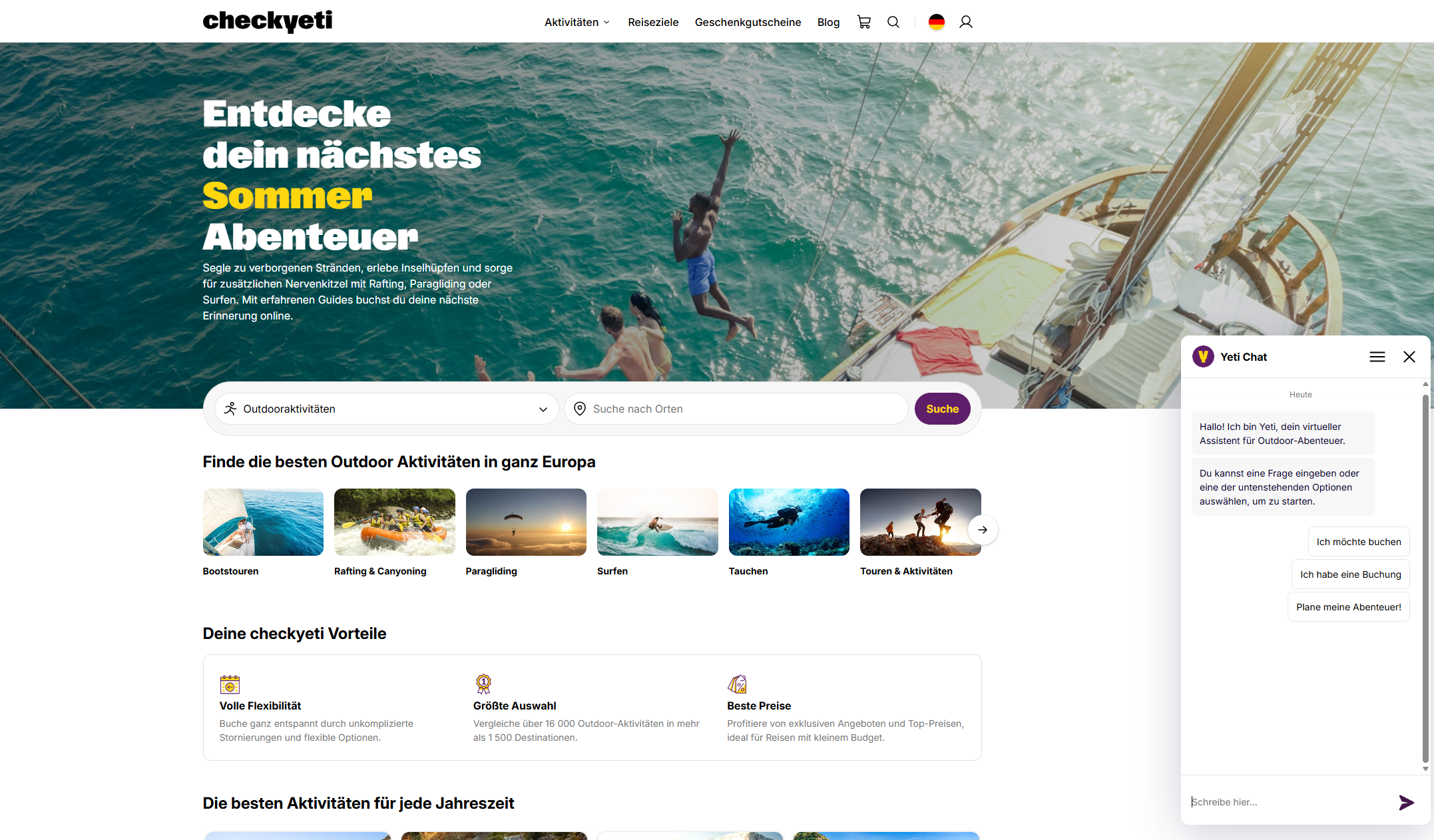
Chatbot on the website: customers get a recommendation right in the conversation and can book from there – noticeably faster than via a ticket.
Helpdesk Agent in the Zendesk helpdesk: for written requests, the AI agent answers follow-up questions and makes recommendations without an agent stepping in.
Importantly: checkyeti deliberately did not set out to automate 90 or 100% of requests. Some tickets should still be answered by people, because not every request is suited to a fully automated answer. The goal was a defined touch rate of 70% – and that's exactly what was reached: from January 1 to 25, 2026, the touch rate was 71%. In the same period, 361 customers were advised automatically and guided to the right ski lesson or summer activity.
Results: two channels, one system
The figures from live operation show how both channels work together:
Helpdesk Agent:
- 465,787 website visitors
- 2,031 leads, 1,015 of them with a touchpoint (touch rate 50%)
- 402 bookings from 211 customers
- Conversion rate: 21%
Shop Agent:
- 2,471 interactions
- 173 bookings from 88 customers
- Conversion rate: 4%
The team at checkyeti also reports that the chatbot answers reliably and appropriately in around 70–80% of cases – and that customers respond well to its recommendations. In some months, bookings jumped sharply: on a single day, according to checkyeti, 24 bookings came in via the Shop Agent after volume had been building steadily.
Advice that never clocks off
The biggest effect for checkyeti isn't actually the automation rate itself, but something harder to express in percentages: availability. Before melibo, support relied on fixed shifts, including separate weekend coverage. Today, the Helpdesk Agent handles such a large share of recurring requests that checkyeti can do without these weekend shifts – the chatbot gives advice at night too.
This pays off especially for international customers in different time zones: anyone with a question outside classic service hours still gets a fitting answer instantly – and books faster instead of waiting for a reply the next business day.
Outlook: more real time, more APIs, deeper advice
For checkyeti and melibo, today's solution is a foundation that brings noticeable relief, but it's far from the final stage. Concrete plans include:
- More live availability via APIs: for some products – such as boat tours – the Shop Agent can already show in real time how many spots are left, because the reservation system is connected via API. This principle will be extended to more activities.
- More precise attribution: bookings are currently tracked mainly via links from the Shop Agent. Going forward, this will happen automatically via cookies, so bookings made shortly after without a direct click on the link can also be attributed correctly.
- Deeper advice: instead of only recommending classes, the Shop Agent will also advise on extras like equipment rental and integrate additional information like meeting points directly into booking advice.
- Reporting from real customer conversations: ongoing conversations will be used to identify content gaps on the website and continuously improve the knowledge base.
What other booking platforms can learn from checkyeti
The collaboration between checkyeti and melibo shows: complex, individual products – whether activities, experiences or services – aren't an obstacle to automated customer advice, but exactly the setting where it makes the biggest difference. What matters isn't the highest possible automation rate, but a realistic, jointly defined goal – and an AI agent that truly understands complex requirements instead of just delivering standard answers.
Conclusion
With the melibo Shop Agent and the Helpdesk Agent in the Zendesk helpdesk, checkyeti has automated advisory logic that demands considerable process knowledge even from experienced staff. The result: a touch rate of 71%, hundreds of automatically advised customers per month and customer service that no longer has to think in shifts – but is there around the clock for customers from all over the world.


