Introduction
Modern customer expectations in customer service are clear: fast answers, precise information and, when needed, a direct human contact. To meet these expectations efficiently, securely and at scale, neither purely human support nor a purely automated system is enough. Progress comes from targeted collaboration between strong AI solutions – especially large language models (LLMs) – and qualified service employees.
This hybrid model raises service quality: AI-powered chatbots and assistants handle routine requests around the clock, while human experts take over in complex, emotional or security-relevant cases. What's crucial is a seamless human handover with clear escalation paths, clear context transfer, compliance and GDPR conformity – the intelligent handover from the AI system to a human in omnichannel customer service.
Human handover: what does it mean today with LLMs?
Human handover refers to the targeted process of transferring an ongoing conversation from a chatbot or LLM system to a real person in support. This process has evolved in recent years – away from rigid forwarding toward dynamic handovers based on real-time detection and contextual understanding.
A modern language model can do a lot today: it understands context, recognizes moods, offers structured knowledge and can even handle several concerns in one chat. Still, it reaches its limits – for example with legally sensitive topics, in emotionally charged situations or when creative decisions are needed.
That's when the human handover kicks in: the system recognizes that a human is better suited, passes on all information so far and a support employee takes over – without loss of information, without interruption and without frustration for the user.
When should a human take over? Typical triggers in the LLM era
Even though AI systems with LLMs now have impressive capabilities, certain scenarios are clear signals that a human handover is needed:
- Complex, multi-step concerns: As soon as a request involves several topics or specific expert knowledge that can't be fully automated.
- Emotional or escalating communication: When users express dissatisfaction, seem annoyed or threaten to leave, empathy is needed – a skill AI can only imitate to a very limited extent.
- High-value contacts: In cases with potentially high revenue, contract signing or long-term loyalty, personal care pays off.
- Unclear language or ambiguity: Dialects, colloquial expressions or vaguely phrased concerns are often easier for people to understand than for machines.
- Uncertainty recognized by the AI itself: Modern models signal their own uncertainty when they can't give a reliable answer on a topic – that's the ideal moment for a handover.
- User request for human contact: Some users simply prefer to talk to people. Systems should respect this and make it easy.
Why is an intelligent handover more important than ever today?
Technological progress has made customer support more efficient – but not more human. Especially in times of increasing automation, the human factor becomes more important. Customers want to feel understood – not just processed.
A clean human handover contributes significantly to customer satisfaction, reduces waiting times, improves first contact resolution and prevents unnecessary escalations. Companies that clearly define the handover process and integrate it into their support strategy can:
- Scale efficiently: Standard requests are answered automatically, critical cases are handed over in a targeted way.
- Ensure brand consistency: Humans make sure tone, values and responses match the company's identity.
- Strengthen trust: Users know they're not stuck in an endless loop with a bot but can get competent help at any time.
- Reduce support costs: Smart pre-selection and prioritization mean only relevant cases are escalated.
How a modern handover with AI systems works
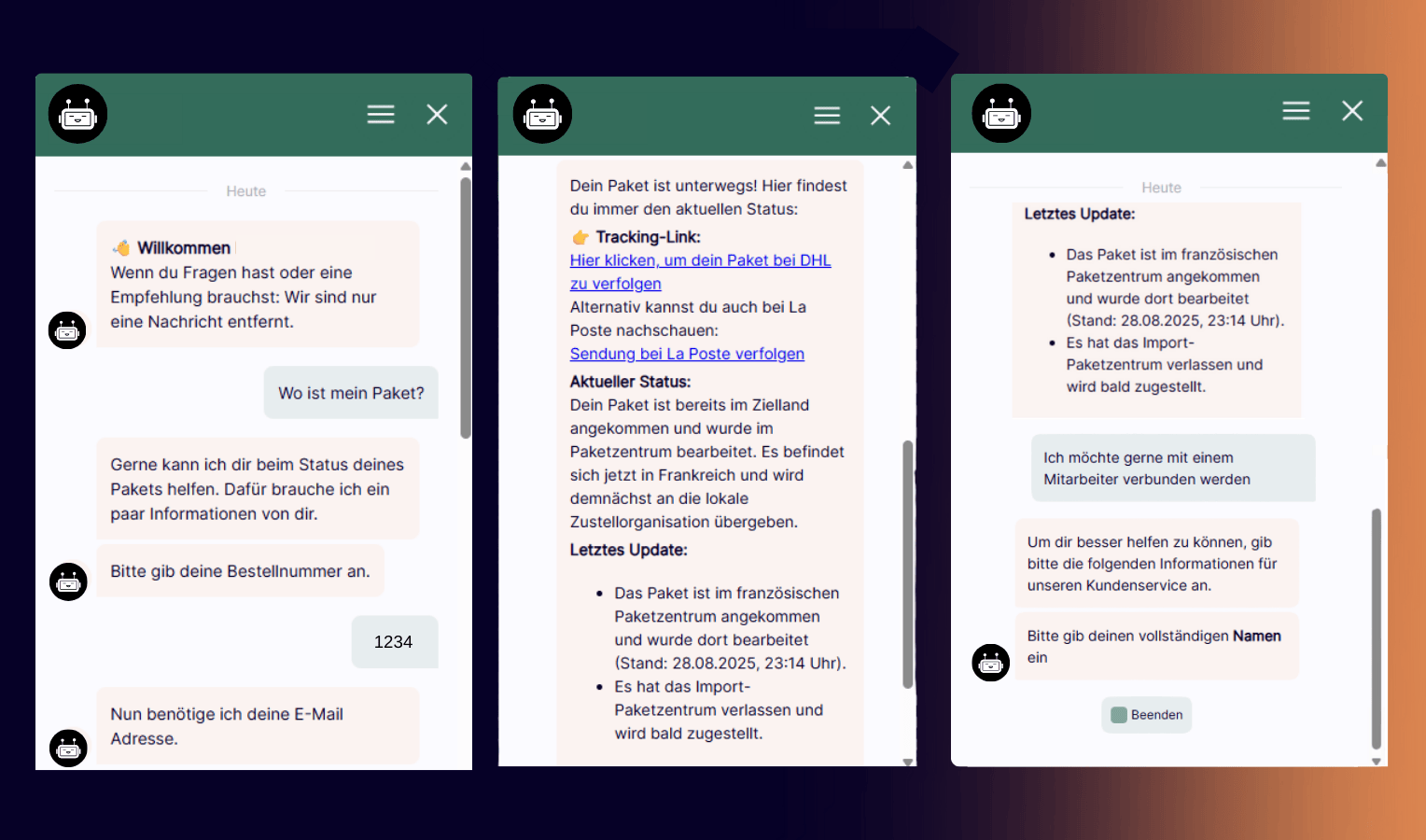
A professionally designed human handover today runs in several steps. What matters: every step serves the goal of making the transition smooth, traceable and customer-focused.
- Analysis & trigger definition
Clear criteria determine when a human should take over. These triggers are based on language, recognition rate, user behavior, feedback or the complexity of the topic.
- Context-aware decision by the AI system
The LLM recognizes in real time when its answer quality isn't sufficient and suggests a handover – ideally with a reason.
- Seamless handover with full context
The human receives all information from the conversation so far: conversation history, user profile, actions taken and sentiment analysis.
- Transparent communication with the user
The bot announces the handover – friendly, clear and understandable: "I'm getting some support for you – a colleague will take over in a moment."
- Personal continuation by the human
The support employee picks up the conversation without the user having to repeat themselves. This creates continuity and trust.
- Feedback & optimization
After completion, the system analyzes why the handover happened, how efficient the process was and whether adjustments are needed – e.g. to the triggers or the model's answers.
Best practices for successful human handover processes
To make the transition between bot and human a strength rather than a weak spot, keep the following points in mind:
- Clear change of roles: Users should know when they're interacting with AI and when a human takes over.
- No loss of information: Human support must be able to continue exactly where the system left off.
- Empathy training for employees: Especially in escalated or critical cases, tact and solution-oriented action are crucial.
- Flexible trigger mechanisms: These should be optimized regularly based on real conversations and feedback data.
- Consistent style: Even when human and machine take turns, the communication style should stay consistent.
- Data protection & transparency: Users need to know what happens to their data – especially when the conversation partner changes.
Challenges & how to master them
Despite all progress, there are challenges to consider when building a human handover process:
- Misinterpretation by the AI system: Even large language models can make wrong assumptions – regular monitoring is therefore a must.
- Too many or too few handovers: Poor trigger settings lead to unnecessary escalations or user frustration – this needs fine-tuning.
- Technical breaks: If the transition doesn't work cleanly from a technical standpoint, the user experience suffers massively.
- Lack of training on the human side: Even the best handover process achieves little if the human doesn't know how to handle the cases they take over.
- Data protection questions: Handovers must comply with data protection law – especially with sensitive user information.
Conclusion: collaboration isn't a trend but a necessity
The idea that machines could completely replace humans is long outdated. The real strength lies in intelligent collaboration: AI systems excel at repetition, data processing and speed – while humans stand out for empathy, judgment and emotional intelligence.
A structured, context-rich and smooth human handover is therefore not just helpful but essential for creating a modern support experience. If you coordinate the combination of automation and human care optimally, you can increase customer satisfaction, lower costs and clearly stand out from the competition.