


Introduction: when machines speak, they learn
Whether you knew it or not, you've most likely already interacted with conversational AI. Whether in an online store's customer chat, giving a voice command to your smartphone or booking an appointment via a chatbot: machines are learning to speak – and to understand.
In 2025, conversational artificial intelligence is no longer a gimmick but a key technology that is changing communication, customer service, marketing and HR for good. But how does it work, how "human" can it become – and where is it heading?
What is conversational AI?
Conversational AI refers to systems that can hold natural conversations with people – via text or voice. They combine natural language processing (NLP), machine learning, speech recognition and context-based understanding to understand questions, recognize intents and respond in a human-sounding way.
In other words: conversational AI is the ability of machines to communicate like a human – not just by recognizing words but by understanding meaning, emotion and context.
A brief look back: from AI to conversational AI
Artificial intelligence (AI) – as John McCarthy defined it back in 2004 – is the science of teaching machines intelligent behavior. Initially, the focus was on data processing, pattern recognition and automation.
Today, communication is the new focal point. Because language is the most natural way for people to share knowledge, express emotions and build relationships.
Conversational AI therefore marks the step from pure information processing to empathetic interaction – a milestone on the way to human-like AI.
How does conversational AI work?
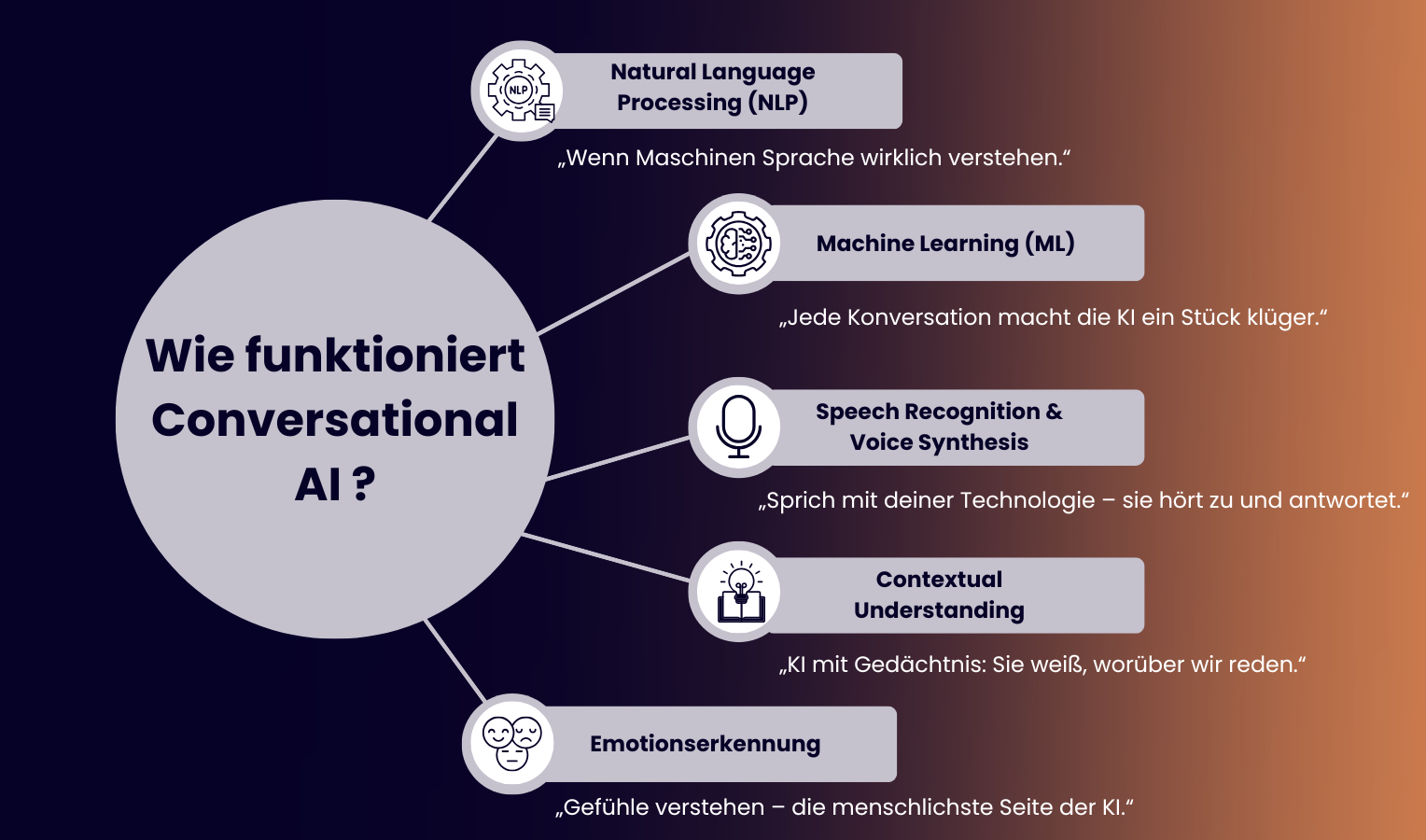
A modern conversational AI solution combines several key technologies:
- Natural language processing (NLP):
The AI analyzes words, sentence structure and meaning to understand the user's intent.
- Machine learning (ML):
The system continuously learns from previous conversations to give better answers.
- Speech recognition & voice synthesis:
Speech is converted into text – and answers can be spoken back.
- Contextual understanding:
Modern systems keep the conversation context across several interactions – so they know "what we're talking about right now".
- Emotion recognition:
Through tone, word choice and sentence rhythm, AI today can even recognize emotions – and respond empathetically.
The result is a dialog that feels increasingly human – natural, fluid and context-aware.
Conversational AI chatbots: the new standard for communication
Conversational AI chatbots are the most visible representatives of this technology. Unlike simple rule-based bots, they don't just understand keywords but entire contexts.
They respond dynamically, ask follow-up questions and adapt their tone. This enables them to imitate human conversations realistically.
Typical areas of use:
- Customer service: 24/7 support, automated answers to requests
- E-commerce: product recommendations, cart assistance
- HR & recruiting: applicant communication, onboarding, employee support
- Financial services: account information, claims reports, advice
- Healthcare: appointment scheduling, initial assessments, health information
From bot to digital assistant
Development since 2022 has been rapid. Rigid chatbots have become learning, context-aware systems that can hold real dialogs.
Between 2023 and 2025, there were three major advances in particular:
1. Contextual understanding
Conversational AI today can follow conversations across many interactions. It remembers what was said before and can keep the thread – much like a person in conversation.
2. Multimodal communication
Text, voice, images and even gestures are combined. Chatbots in 2025 understand spoken, written or visual input – and respond according to the situation.
3. Emotional intelligence
Thanks to sentiment analysis, systems today recognize whether a user is frustrated, curious or annoyed – and adapt their answers.
This makes interaction not only efficient but also empathetic.
The impact of ChatGPT and modern language models
A key driver of this development was the release of large language models such as OpenAI's ChatGPT. Since 2022, ChatGPT has shown how naturally AI can communicate with people.
These models have revolutionized conversational AI – they are:
- linguistically versatile (multilingual),
- context-sensitive,
- and can adopt individual styles, brand voices and tones.
In 2025, companies increasingly use independently trained GPT models that work with company-specific knowledge – from customer support to HR chatbots.
New developments in 2025
In 2025, conversational AI is entering a new phase – it is ready for integration at every level:
- Seamless system integration: Chatbots are directly connected to CRM, ERP and HR systems.
- Real-time analysis: Data from customer conversations flows directly into decision-making.
- Self-learning engines: Systems learn independently from feedback and errors, without manual training.
- Voice-first interfaces: Voice control is increasingly becoming standard – from smartwatches to cars.
- AI with personality: Companies give their chatbots their own identity – with a coordinated tone, humor or brand voice.
Areas of application for conversational AI
1. Customer service
The most important area of application remains digital customer support. Conversational AI responds instantly, can hold several conversations in parallel and solves routine questions in seconds.
The result: higher customer satisfaction and lower support costs.
2. Marketing & sales
Conversational AI accompanies users along the entire customer journey – from advice to purchase. It recommends products, personalizes offers and thus increases the conversion rate.
3. HR & recruiting
In HR departments, chatbots today conduct job interviews, answer new employees' questions and help with onboarding. This saves time and improves the employee experience.
4. Education & e-learning
Virtual tutors help learners understand complex topics and adapt individually to their learning progress.
5. Smart devices & IoT
Voice assistants such as Alexa, Google Assistant, Siri or integrated systems in cars and household appliances use conversational AI to make devices more intuitive to control.
Challenges: how human should AI be?
Despite all progress, one key question remains:
How human should machines actually become?
The boundaries between authenticity and deception must remain clearly defined. Transparency is crucial – users should always know whether they're talking to a human or an AI.
Equally important are:
- data protection and ethics,
- bias control in training data,
- and preserving human freedom of decision.
Conversational AI should support, not replace – it's a tool, not a substitute for empathy.
Outlook: conversational AI up to 2030
The coming years promise an even closer fusion of human and machine. Five trends are shaping the future:
- Hyper-personalized communication:
AI understands individual needs, emotions and contexts – and delivers tailored answers in real time.
- Multimodal avatars:
Digital assistants appear as realistic 3D avatars that can speak, see and react.
- Predictive conversation:
Systems proactively recognize what a user needs before they ask – for example in customer service or e-commerce.
- Seamless integration into the metaverse:
Conversational AI becomes the voice of digital worlds and virtual work environments.
- Ethical AI & trust management:
Transparent, explainable AI becomes mandatory. Users expect traceability – not magic.
Conclusion: humanity as the benchmark for technology
In just a few years, conversational AI has evolved from simple chatbots into intelligent, empathetic conversation partners. In 2025, it's no longer a project for the future but an integral part of our daily interaction – at work, in everyday life and in our free time.
But for all its technical brilliance, one thing remains clear:
Humans are the measure of the machine.
The best conversational AI systems aren't the ones that imitate perfectly but the ones that support, understand and build trust.
They enable communication that is accessible, inclusive and emotionally intelligent – and may thus achieve technology's greatest goal:
not to seem more human, but to strengthen what's human.


