
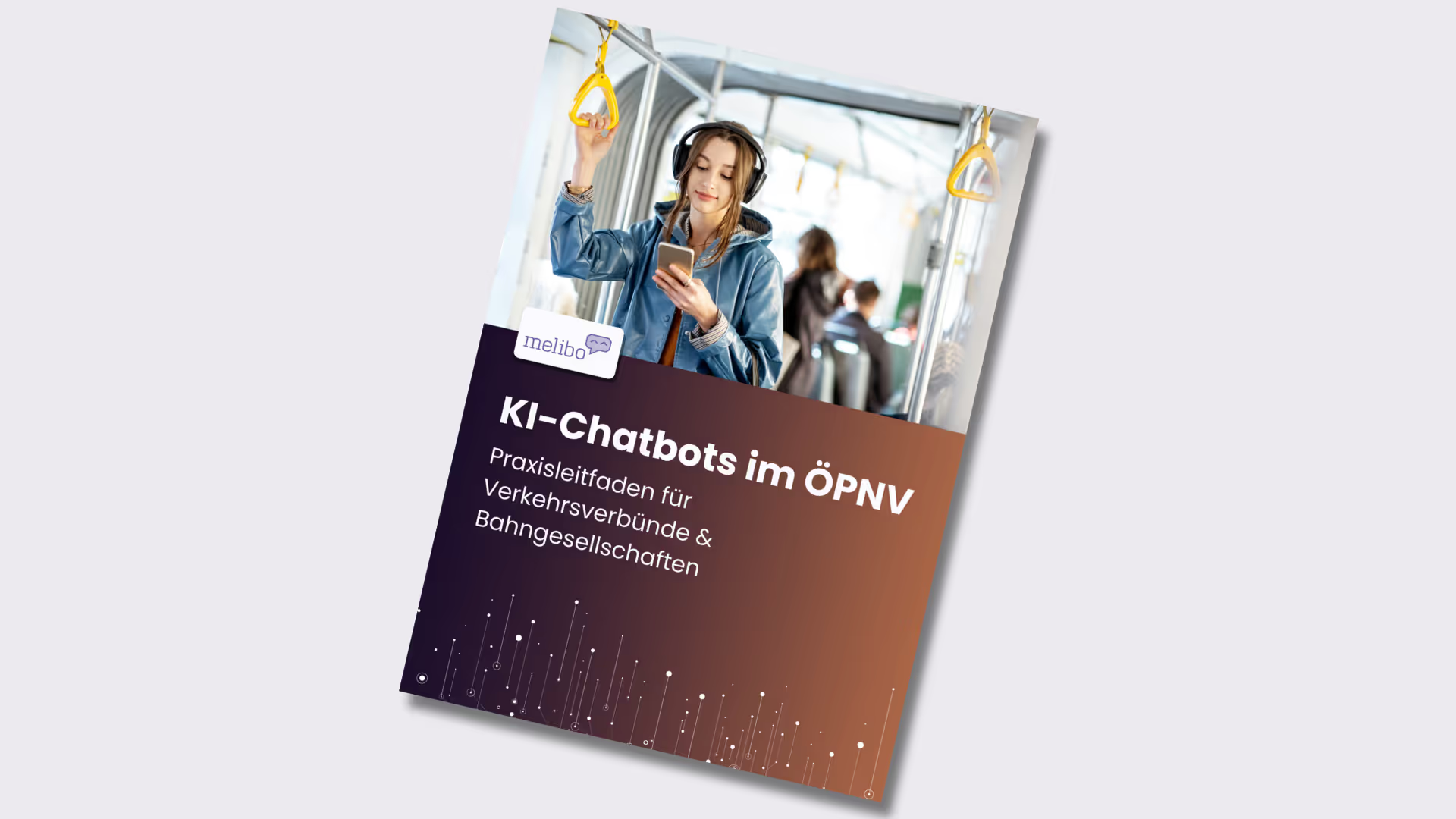
What to expect in the guide "AI chatbots in public transport"
Why are AI chatbots in public transport relevant now?
This chapter gives a compact overview of the role AI chatbots play in modern public transport customer service. The guide shows how transport associations answer recurring requests automatically, absorb peaks and still ensure high answer quality.
The focus is on scalable availability, consistent information across all channels and a clear split between automatable standard cases and human handling of special cases.
What challenges does public transport customer service face today?
Passengers expect fast, clear and reliable information – especially on journey planning (A→B), tickets, zones, fares, special rules and disruptions. This chapter shows why these expectations often run into fragmented knowledge, fluctuating demand and manual processes in day-to-day work.
The guide explains where typical bottlenecks arise, why waiting times rise at peak times and why a lack of automation leads to inconsistent answers and high operating costs.
How does a robust AI chatbot for transport associations work?
This chapter answers the question of how a reliable AI chatbot for public transport is built. It centers on three core building blocks: a central knowledge base (Knowledge Hub), clearly defined workflows for prioritized use cases and generative AI within fixed guardrails.
The guide shows how reviewed content, source references and structured escalations work together to enable transparent, traceable and auditable answers.
Which use cases are especially suited to AI in public transport?
Here the guide shows which use cases benefit most from AI automation. These include journey planning with transfers and disruptions, ticket advice with zone and validity logic, fares and discount models, student tickets, timetable changes and taking bikes on board.
It explains where the level of automation is high, where governance becomes crucial and how special cases are reliably handed over to staff.
What does the architecture of an AI chatbot in public transport look like?
This chapter looks at the technical side and describes the target architecture of an AI chatbot in public transport – made up of frontend, bot layer, Knowledge Hub and integration layer.
Concrete examples show how timetable and disruption APIs, knowledge bases and helpdesk and CRM systems are connected, with a focus on stability, performance and transparency.
How are data privacy, security and accessibility ensured?
Transport associations face especially high requirements. This chapter answers the question of how AI chatbots can be run in a GDPR-compliant, secure and accessible way.
It covers data minimization, role and permission concepts, logging, WCAG-compliant chat widgets and transparent handling of uncertainty and sources. The goal is a service that is trustworthy, inclusive and legally sound.
How do you implement an AI solution in public transport?
This chapter walks step by step through the path from analysis to live operation. It covers identifying suitable use cases, system integration, testing, team training and continuous optimization based on relevant KPIs.
The focus is on establishing AI not as a one-off project but as a long-term, scalable service component in public transport.
What results do transport associations achieve with AI chatbots?
Finally, the guide uses a real success story to show how AI chatbots are used successfully in public transport.
It describes the starting point, the approach and measurable results – including high automation rates, very short response times and noticeable relief for the service team, especially at peak times.